
Agricultural and plantation companies generate millions of tons of biomass residues every year, including rice husks, sugarcane bagasse, palm shell, and corn stover. Most of it is burned openly or left to decompose, releasing stored carbon back into the atmosphere and creating a measurable liability for companies under growing ESG scrutiny.
For corporate sustainability managers, this creates a compounding problem. Regulators, investors, and supply chain partners are increasingly demanding credible emissions reduction plans, yet turning raw biomass waste into a verifiable climate asset has historically seemed technically complex and commercially out of reach.
Pyrolysis changes that equation. By converting biomass waste into biochar through a controlled thermochemical process, companies can permanently sequester carbon, generate high-integrity carbon credits, and create a measurable contribution to their net-zero targets. Understanding what is pyrolysis and how it works is the first step toward unlocking that value.
What is Pyrolysis?
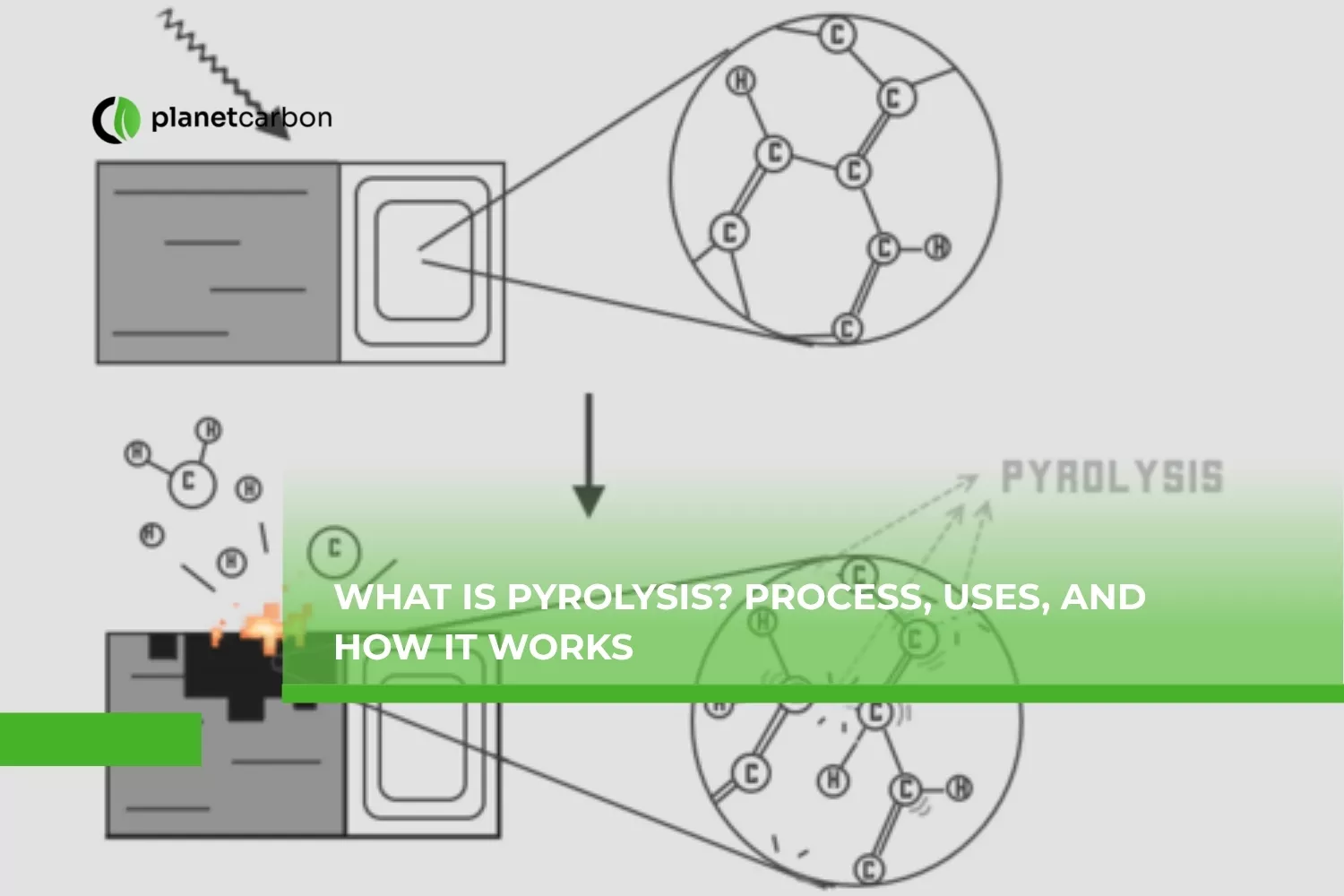
Pyrolysis is a thermochemical decomposition process that breaks down organic material at elevated temperatures in the complete absence of oxygen. Unlike combustion, which requires oxygen to burn material and releases most of its carbon as CO2, pyrolysis transforms biomass into stable solid, liquid, and gaseous outputs without open-flame oxidation.
The word itself comes from the Greek roots “pyr” (fire) and “lysis” (separation or breaking down), which accurately describes the mechanism: heat is used not to burn material, but to chemically separate and restructure its molecular components. This distinction is critical because it is precisely what makes pyrolysis a recognized pathway for durable carbon removal rather than a simple waste disposal method.
In industrial and agricultural contexts, the organic feedstock fed into a pyrolysis reactor is typically biomass residue, including woody biomass, crop waste, or organic sludge. The process operates at temperatures generally ranging from 300°C to 700°C, and the specific conditions applied, primarily temperature and residence time, determine which output products dominate and in what proportion.
Three Types of Pyrolysis and Their Characteristics
Not all pyrolysis processes are designed the same way. The three main variants differ significantly in their operating conditions and the balance of outputs they produce, so selecting the right type depends on whether the primary goal is biochar production, bio-oil recovery, or syngas generation.
1. Slow Pyrolysis
Slow pyrolysis operates at relatively low temperatures, typically between 300°C and 500°C, with long residence times that can extend from hours to days. Because the biomass is exposed to heat gradually, the process favors solid carbon formation, making slow pyrolysis the most established method for producing high-yield, high-stability biochar.
The biochar produced through slow pyrolysis typically contains 70 to 80 percent carbon by mass, with a highly stable aromatic structure that resists biological decomposition for hundreds to thousands of years. This durability is what underpins its value in the carbon market, because carbon sequestered in stable biochar is genuinely removed from the active carbon cycle for the long term.
2. Fast Pyrolysis
Fast pyrolysis is engineered for speed, using very high heat transfer rates and short residence times of just a few seconds to maximize the yield of bio-oil, also called pyrolysis oil or biocrude. Operating temperatures typically sit between 400°C and 600°C, and the rapid thermal processing means less time for solid carbon to form, so biochar yield is lower compared to slow pyrolysis.
Bio-oil from fast pyrolysis can serve as a feedstock for renewable fuel production or as a chemical precursor in various industrial applications. However, for companies whose primary objective is carbon sequestration and credit generation rather than liquid fuel production, fast pyrolysis is generally a secondary consideration relative to slow pyrolysis.
3. Flash Pyrolysis
Flash pyrolysis represents the extreme end of the speed spectrum, with residence times measured in milliseconds and temperatures that can exceed 700°C. The process is optimized to maximize syngas output, a mixture primarily composed of hydrogen and carbon monoxide that can be used for power generation or as a building block for synthetic fuels.
While flash pyrolysis has interesting energy applications, its very short reaction time leaves minimal opportunity for stable biochar formation. As a result, it is less relevant to biochar-based carbon removal projects and is more commonly discussed in the context of advanced bioenergy and hydrogen production research.
Main Pyrolysis Products and Their Economic Value
Every pyrolysis process produces three core outputs simultaneously: biochar, bio-oil, and syngas. Their relative proportions shift depending on the operating conditions applied, but all three carry distinct economic and environmental relevance.
Biochar is the solid carbon-rich residue left after pyrolysis. In an agricultural context, it can be applied directly to soils as a long-term amendment that improves water retention, enhances nutrient availability, and supports microbial activity, all while keeping sequestered carbon locked away from the atmosphere. When produced under a recognized international carbon certification standard and registered on a publicly auditable carbon registry, biochar qualifies as a high-permanence carbon removal credit in the voluntary carbon market.
Bio-oil, the liquid fraction, is a complex mixture of organic compounds that can be refined into renewable fuels or used as industrial feedstock. Syngas, the gaseous fraction, is combustible and is frequently captured to power the pyrolysis reactor itself, which substantially reduces the external energy input required to run the operation and improves the overall energy balance and economics of the project. Together, these three output streams mean that a well-designed pyrolysis facility does not simply manage waste, it generates multiple layers of measurable value from feedstock that would otherwise be a liability.
Read Also : The Scientific Difference Between Biochar and Regular Charcoal
Why Biochar from Pyrolysis Is Recognized in the Carbon Market
The voluntary carbon market increasingly distinguishes between carbon avoidance credits, which prevent emissions from occurring, and carbon removal credits, which physically extract CO2 from the atmosphere and store it durably. Biochar carbon removal falls firmly in the second category, and that distinction matters because buyers seeking to meet Science Based Targets initiative (SBTi) commitments or Oxford Principles-aligned net-zero claims are under growing pressure to prioritize removal over avoidance.
Biochar’s permanence is a key technical credential. Independent research published by the Intergovernmental Panel on Climate Change (IPCC) recognizes biochar as a carbon dioxide removal technology, noting that its highly condensed aromatic carbon structure gives it a mean residence time in soil that can exceed 1,000 years under typical conditions. This is a meaningful contrast to nature-based avoidance credits, which carry reversal risks from fire, drought, or land-use change.
Under Indonesia’s regulatory framework, Presidential Regulation No. 110 of 2025 (Perpres 110/2025), which replaced the earlier Perpres 98/2021, establishes the legal basis for the national carbon economy (NEK) and creates the compliance architecture within which carbon removal activities, including biochar projects, can be developed and registered. This regulatory clarity makes biochar carbon removal an increasingly viable strategic option for Indonesian companies with biomass-generating operations.
Ideal Biomass Requirements for Pyrolysis
Not all biomass feedstocks perform equally in a pyrolysis reactor. The quality, consistency, and physical characteristics of the input material directly affect both the efficiency of the thermochemical conversion and the quality of the biochar produced, so feedstock assessment is a necessary early step in any project development process.
Moisture content is one of the most critical variables. Feedstock with moisture content above 30 to 35 percent requires significant pre-drying energy, which adds cost and can erode the net energy and carbon balance of the project. Ideally, biomass entering the reactor has moisture content below 15 to 20 percent, either through natural sun drying or a pre-treatment step built into the facility design.
Particle size and bulk density also influence heat transfer efficiency inside the reactor. Uniformly sized feedstock allows for more consistent thermal exposure across the material, which produces more homogeneous biochar with predictable carbon content and stability. Agricultural residues such as rice husks, palm shells, and corn cobs tend to perform well precisely because their natural structure and relatively low moisture levels align closely with these requirements, making them well-suited for biochar production at meaningful scale.
Ash content is a further consideration, as high-ash feedstocks, such as certain straws or rice husks depending on origin, can affect the surface chemistry and agronomic performance of the resulting biochar. A thorough feedstock characterization, including elemental analysis and proximate analysis, is standard practice before committing to a specific pyrolysis configuration, and it is a step that credible biochar project developers include as part of their technical due diligence.
Pyrolysis in the Context of Corporate Net Zero Strategy
For companies in agriculture, agro-processing, or plantation sectors, thermochemical conversion of biomass through pyrolysis offers something that most other sustainability interventions cannot: a direct link between an existing operational waste stream and a high-integrity, tradeable carbon asset. This connection is increasingly relevant as corporate climate commitments move from voluntary pledges to auditable obligations under frameworks such as SBTi and the Integrity Council for the Voluntary Carbon Market’s (ICVCM) Core Carbon Principles (CCP).
The strategic logic is straightforward. Biomass that would otherwise be burned or left to decay carries an implicit emissions liability. Converting that biomass to biochar through pyrolysis converts the liability into a measurable carbon removal unit, which can either be used to offset residual company emissions or sold into the voluntary or compliance carbon market as a revenue-generating asset.
Integrating a pyrolysis-based biochar project into a corporate ESG carbon strategy also requires a credible MRV (Monitoring, Reporting, and Verification) framework. Carbon credits generated from biochar must be quantified using approved methodologies, validated and verified by an accredited independent verification body, and issued through a publicly auditable carbon registry before they carry any market value. Companies that invest in understanding the full process from feedstock sourcing through to credit issuance are better positioned to capture that value efficiently and to withstand the scrutiny that buyers and regulators increasingly apply.
Start Exploring Pyrolysis Potential with Planet Carbon
If your company generates agricultural or plantation biomass residues and you are trying to understand whether a pyrolysis-based biochar project makes sense for your operations, the most useful next step is a grounded technical and commercial conversation rather than further desk research.
Planet Carbon works with biomass owners, agro-processors, and sustainability teams across the region to assess feedstock viability, design appropriate pyrolysis configurations, and develop the MRV infrastructure needed to generate high-integrity carbon credits. The platform covers the full development cycle, from initial feasibility through validation and into commercialization, so companies do not have to piece together different service providers at each stage.
If you are ready to explore what your biomass waste could realistically contribute to your net-zero targets, reach out to the Planet Carbon team for a no-obligation project scoping discussion. The conversation is a practical starting point, and it is grounded in the same rigorous process that credible biochar carbon removal projects are built on.
Referensi:
- IPCC Sixth Assessment Report (AR6), Working Group III, Chapter 12: Pyrolysis-biochar systems recognized as a carbon dioxide removal pathway, with mean residence time of biochar carbon in soil exceeding 1,000 years under typical conditions. Available at: https://www.ipcc.ch/report/ar6/wg3/
- Intergovernmental Panel on Climate Change (IPCC): Biochar carbon stability and permanence data referenced in multiple AR6 Working Group III technical annexes. Available at: https://www.ipcc.ch
- U.S. Department of Agriculture, Agricultural Research Service (USDA ARS): Overview of biomass pyrolysis process, product fractions, and temperature ranges. Available at: https://www.ars.usda.gov/northeast-area/wyndmoor-pa/eastern-regional-research-center/docs/biomass-pyrolysis-research-1/what-is-pyrolysis/
- Science Based Targets initiative (SBTi): Corporate net-zero standard requirements referencing the role of carbon removal in meeting long-term targets. Available at: https://sciencebasedtargets.org
- Integrity Council for the Voluntary Carbon Market (ICVCM): Core Carbon Principles (CCP) framework for high-integrity carbon credit eligibility. Available at: https://icvcm.org
- Peraturan Presiden Republik Indonesia Nomor 110 Tahun 2025 tentang Nilai Ekonomi Karbon (NEK): Legal basis for Indonesia’s carbon economy framework, replacing Perpres 98/2021. Available at: https://peraturan.go.id/id/perpres-no-110-tahun-2025
Read Also : Turning Rice Husks into Biochar: Land Benefits, Carbon, and Business Opportunities