
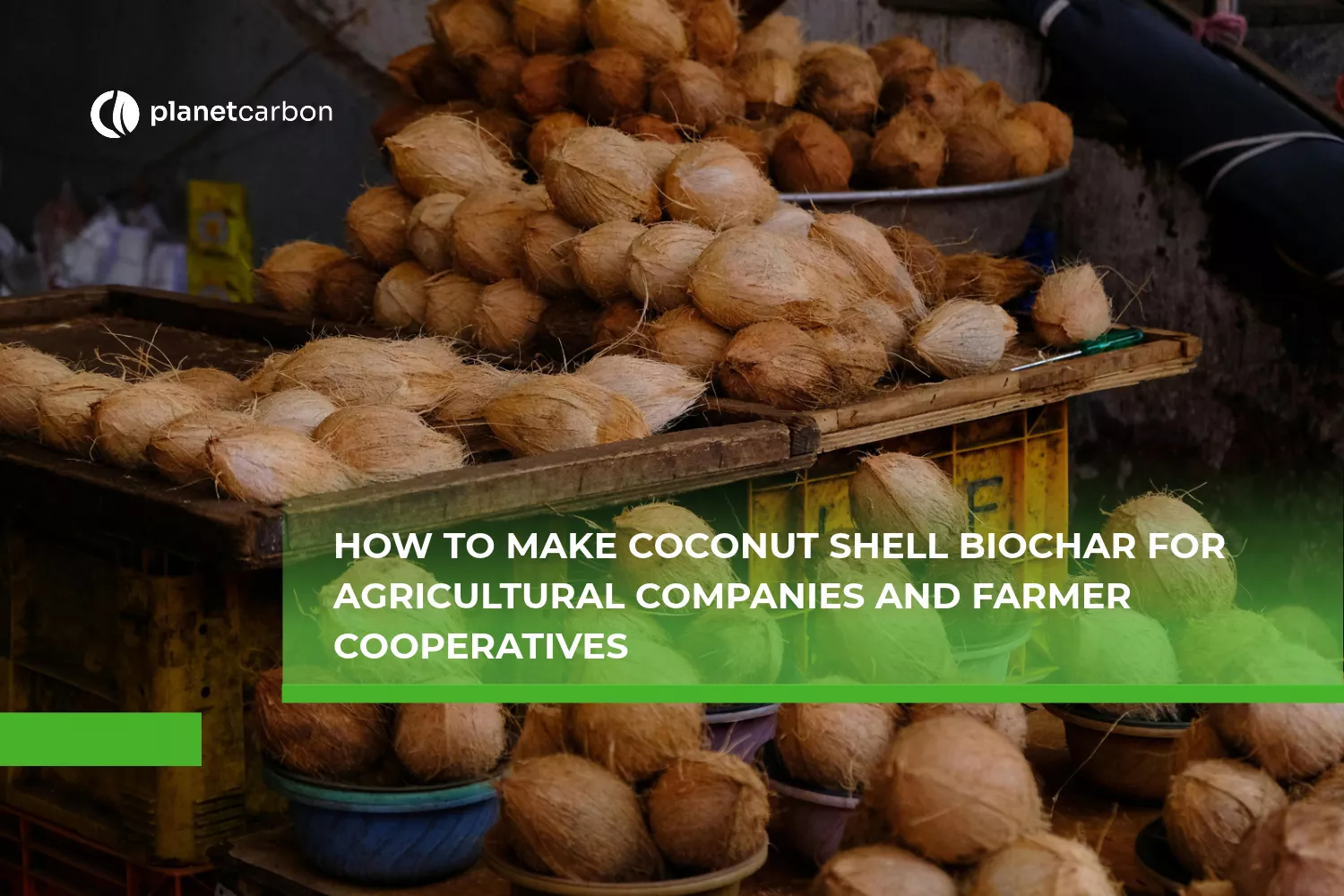
Coconut plantations across Southeast Asia generate millions of tons of shell waste each year, and most of it ends up burned in open fields or left to decompose. Both outcomes release CO₂ back into the atmosphere, so the very biomass that could have captured carbon becomes a liability instead.
For agribusinesses navigating tighter ESG reporting requirements and increasingly scrutinized Scope 3 emissions, this is more than a waste management problem. It is a missed financial opportunity sitting right inside the supply chain.
Coconut shell biochar offers a concrete way to close that gap. By converting shell waste through a controlled thermal process, companies can produce a stable, carbon-rich material that improves soil performance, qualifies for internationally recognized carbon certification, and generates verifiable carbon credits with long-term permanence.
What is Biochar?
Biochar is a solid, carbon-dense material produced when organic biomass, such as agricultural residues, wood chips, or coconut shells, is heated at high temperatures in an environment with limited or no oxygen. This process, known as biomass pyrolysis, prevents complete combustion and instead locks the carbon within the biomass into a highly stable solid form.
Unlike compost or mulch, which decompose relatively quickly and return most of their carbon back to the atmosphere, biochar is chemically resistant to microbial breakdown. Studies indicate that its carbon can remain stable in soil for hundreds to thousands of years, which is why biochar is recognized as a high-permanence carbon removal pathway under leading international frameworks including the Oxford Principles for Net Zero Aligned Offsetting.
What makes biochar particularly relevant for the agriculture sector is that it is not just a carbon storage mechanism. It also functions as a soil amendment, improving water retention, nutrient availability, and microbial activity in degraded or low-fertility soils. For agricultural companies managing large land bases, this dual function creates both agronomic value and a credible carbon narrative.
The Coconut Shell Biochar Production Process
Producing coconut shell biochar at a commercially meaningful scale requires more than simply burning shells in a kiln. Each stage of the production process directly affects the quality of the output, the carbon yield, and ultimately the creditability of any carbon claims made downstream.
1. Preparing the Coconut Shell Feedstock
The process begins long before any heat is applied. Coconut shells need to be collected, sorted, and cleaned to remove fiber residue, moisture, and contaminants that would otherwise interfere with pyrolysis efficiency.
Moisture content is a critical variable at this stage. Feedstock that exceeds roughly 15 to 20 percent moisture content will require more energy during pyrolysis to drive off water vapor, which reduces thermal efficiency and can produce inconsistent char quality. Pre-drying under natural airflow or through low-temperature mechanical drying is therefore a standard preparation step for operations targeting a consistent, high-carbon output.
Shell size and particle uniformity also matter. Feeding a pyrolysis unit with uniformly sized shell pieces, rather than a mix of whole shells and fine powder, ensures even heat distribution throughout the reactor chamber and supports a more predictable and auditable production process.
2. The Pyrolysis Process (Core of Biochar Production)
Pyrolysis is the thermal decomposition of organic material at temperatures typically between 400°C and 700°C in the absence of oxygen. At these temperatures, the complex organic polymers in coconut shells, including cellulose, hemicellulose, and lignin, break down into three co-products: biochar (solid), bio-oil (liquid condensate), and syngas (combustible gas).
The temperature and residence time within the reactor are the two variables that most significantly determine the character of the resulting biochar. Higher temperatures above 550°C generally produce biochar with a higher carbon content, a more stable aromatic structure, and a more alkaline pH, all of which are desirable properties for both soil application and carbon credit issuance. Lower temperature pyrolysis, sometimes called slow pyrolysis or torrefaction, tends to yield higher biochar mass but with somewhat lower carbon stability.
For agricultural companies planning to pursue carbon credits, the design of the pyrolysis unit itself carries documentation implications. The reactor type, temperature logging, feedstock input volumes, and residence time must all be systematically recorded to support biochar MRV (Measurement, Reporting, and Verification) processes required by recognized international carbon certification standards.
3. Condensation and Co-product Utilization
As volatile gases exit the reactor during pyrolysis, they can be passed through a condensation system that separates the bio-oil fraction from the non-condensable syngas. Bio-oil, also sometimes called pyrolysis oil or liquid smoke, has commercial applications as a natural preservative in the food and agricultural inputs industry, and as a crop protection agent at the farm level.
Syngas, which contains hydrogen, carbon monoxide, and short-chain hydrocarbons, carries significant calorific value. In an integrated facility, this syngas is typically recirculated back into the pyrolysis unit as a heat source, reducing or eliminating the need for external fuel inputs. This closed-loop energy design is relevant not only for operational cost efficiency but also for the carbon accounting of the overall system, since avoided fossil fuel combustion can contribute to the net carbon balance of the project.
Managing these co-products intentionally rather than treating them as waste is both an economic and environmental consideration. Operations that capture and utilize bio-oil and syngas alongside the biochar itself will generally present a stronger net emissions profile when undergoing third-party verification.
4. Cooling and Storing Biochar
Once pyrolysis is complete, biochar must be cooled in a controlled environment before it is safe to handle, bag, or transport. Hot biochar coming out of a reactor retains significant residual heat and remains reactive to oxygen, which means premature exposure to air can cause spontaneous combustion or quality degradation of the surface structure.
Indirect cooling through jacketed chambers or inert gas purging is the most reliable method for preserving biochar quality at scale. Cooling should bring the material below 40°C before it contacts open air and is transferred to storage. Proper storage in sealed, moisture-resistant containers or silos protects the material from reabsorbing water and from contamination that could affect its certified quality parameters during any subsequent laboratory analysis.
This final handling stage is often underestimated, but it has direct consequences for the ash content, pH stability, and surface area measurements that international carbon certification bodies use to classify biochar quality grades.
Read Also : What is Pyrolysis? Process, Uses, and How It Works
Biochar Quality Standards to Pay Attention To
Not all biochar qualifies for carbon credits or earns premium pricing in the voluntary carbon market. Quality standards exist precisely to distinguish stable, high-permanence carbon removal from low-quality char that may degrade or release its carbon within years rather than centuries.
The two most widely referenced quality parameters are carbon content and H:Corg ratio (the ratio of hydrogen to organic carbon). Biochar with a total organic carbon content exceeding 50 percent and an H:Corg ratio below 0.7 is broadly accepted as meeting the threshold for stable, climate-relevant carbon storage according to recognized international carbon certification standards. Coconut shell feedstock is particularly well-suited to achieving these thresholds because of its high lignin content, which converts efficiently into stable aromatic carbon structures at pyrolysis temperatures above 500°C.
Beyond carbon chemistry, assessed quality parameters typically include pH, ash content, electrical conductivity, surface area (measured in m²/g via BET analysis), bulk density, and the absence of polycyclic aromatic hydrocarbons (PAHs) above defined limits. Agricultural land application requires PAH levels to remain well below international safety thresholds, so any operation planning to sell or apply biochar for soil amendment purposes must include PAH testing as a non-negotiable part of quality assurance. Third-party laboratory analysis by an accredited independent verification body is the standard method for certifying these parameters in a way that can withstand scrutiny from both carbon registries and corporate buyers conducting supplier due diligence.
The Potential of Coconut Shell Biochar for Indonesia’s Carbon Market
Indonesia is one of the world’s largest coconut producers, with annual shell waste estimated at over 800,000 tonnes per year, most of which is either burned in open air or left as landfill. Converting even a fraction of this feedstock into coconut shell biochar would represent a substantial carbon removal opportunity that aligns with both national climate targets and the growing demand from corporate buyers for high-quality, permanent carbon credits.
On the regulatory side, Indonesia’s carbon market framework has been significantly updated through Presidential Regulation No. 110 of 2025 (Perpres 110/2025), which replaced the earlier Perpres 98/2021 and introduced clearer rules for the national carbon economic value (NEK) system. Under this framework, biochar projects that meet the technical and MRV requirements of recognized international carbon certification standards can participate in the voluntary carbon market, with carbon credits issued and traceable through a publicly auditable carbon registry. Carbon units traded domestically are subject to the oversight of Indonesia’s financial authority, and operators planning to participate in the regulated carbon exchange should engage early with the relevant government and regulatory channels to understand eligibility pathways.
For agricultural companies and farmer cooperatives, the economics are tangible. Conservative estimates from published lifecycle analyses place biochar carbon sequestration in the range of 2.0 to 3.2 tonnes of CO₂ equivalent per tonne of biochar produced, depending on feedstock type and pyrolysis conditions. At prevailing voluntary carbon market prices for premium, high-permanence carbon removal, this creates a revenue stream that can partially or fully offset the capital cost of a biochar production facility over a project’s crediting period. When combined with the direct agronomic benefits from soil application and the avoided emissions from open burning of shell waste, the financial case for a well-structured biochar project in Indonesia is increasingly compelling.
Real Benefits of Coconut Shell Biochar for Agricultural Land
The agronomic case for biochar as a soil amendment is supported by a substantial and growing body of peer-reviewed research, particularly for tropical and subtropical soils that tend toward acidity and low organic matter content, which describes a large proportion of Indonesian agricultural land.
Applied to soil, biochar acts as a long-term habitat for soil microbiota and a physical reservoir for both water and nutrients. Its highly porous structure, with surface areas ranging from 200 to over 500 m²/g for high-quality coconut shell biochar, allows it to retain moisture during dry periods and prevent nutrient leaching during heavy rainfall. This is particularly relevant for smallholder and cooperative farming contexts, where irrigation infrastructure is limited and fertilizer inputs represent a significant portion of operating costs.
Peer-reviewed meta-analyses have documented consistent improvements in crop yield following biochar application, with studies reporting average yield increases ranging from 10 to 25 percent across a variety of crops when biochar is applied at rates between 5 and 20 tonnes per hectare. Soil pH also tends to increase, which is beneficial for many food crops that perform poorly in acidic conditions. Beyond yield and chemistry, biochar application has been associated with measurable reductions in nitrous oxide (N₂O) emissions from agricultural soil, a greenhouse gas with a global warming potential approximately 273 times that of CO₂ over a 100-year period, according to the IPCC Sixth Assessment Report.
For agribusinesses integrating coconut shell biochar into their supply chain strategy, these agronomic outcomes are not just agronomic. They are quantifiable, auditable, and increasingly expected by enterprise buyers conducting supplier sustainability assessments under frameworks aligned with the GHG Protocol and Science Based Targets initiative (SBTi) criteria.
Consult Your Coconut Shell Biochar Project with Planet Carbon
Developing a biochar project that meets both agronomic goals and carbon market requirements is a multidisciplinary challenge. It sits at the intersection of engineering, agronomy, carbon accounting, and regulatory navigation, and the decisions made early in the project design stage have long-term consequences for credit eligibility, certification timelines, and investor confidence.
Planet Carbon works with agricultural companies and farmer cooperatives across the full project lifecycle, from initial feasibility and feedstock assessment through to MRV design, independent verification support, and carbon credit commercialization. The platform is built specifically for integrated carbon solutions, which means biochar projects are evaluated not just for their carbon removal potential but for how they connect to real land, real farmers, and real supply chains.
If your organization is sitting on coconut shell waste and you are trying to understand what a credible, commercially viable biochar project would look like in practice, the Planet Carbon team is a practical starting point for that conversation. Reach out through planetcarbon.earth to arrange a no-commitment discussion about your project context, and see where the opportunity actually sits for your operation.
Referensi:
- Food and Agriculture Organization of the United Nations (FAO): Coconut production statistics and agricultural residue estimates for Southeast Asia – https://www.fao.org/faostat
- IPCC Sixth Assessment Report (AR6), Working Group I: Global warming potential of nitrous oxide (N₂O) over a 100-year horizon – https://www.ipcc.ch/report/ar6/wg1/
- Jeffery, S. et al., European Journal of Soil Science / PubMed Central: Meta-analysis of biochar effects on crop yield – https://pmc.ncbi.nlm.nih.gov/articles/PMC9925910/
- Oxford Principles for Net Zero Aligned Offsetting: Framework for high-permanence carbon removal credit quality – https://www.smithschool.ox.ac.uk/research/oxford-offsetting-principles
- Integrity Council for the Voluntary Carbon Market (ICVCM): Core Carbon Principles (CCP) guidance on carbon permanence and MRV standards – https://icvcm.org/core-carbon-principles/
- GHG Protocol: Corporate accounting and reporting standards for Scope 3 emissions – https://ghgprotocol.org/
- Science Based Targets initiative (SBTi): Corporate net-zero standard and supplier engagement criteria – https://sciencebasedtargets.org/
- Pemerintah Republik Indonesia: Peraturan Presiden Nomor 110 Tahun 2025 tentang Nilai Ekonomi Karbon – https://peraturan.go.id/id/perpres-no-110-tahun-2025
Read Also : The Right Way to Apply Biochar to Crops for Optimal Yields and More Fertile Soil