


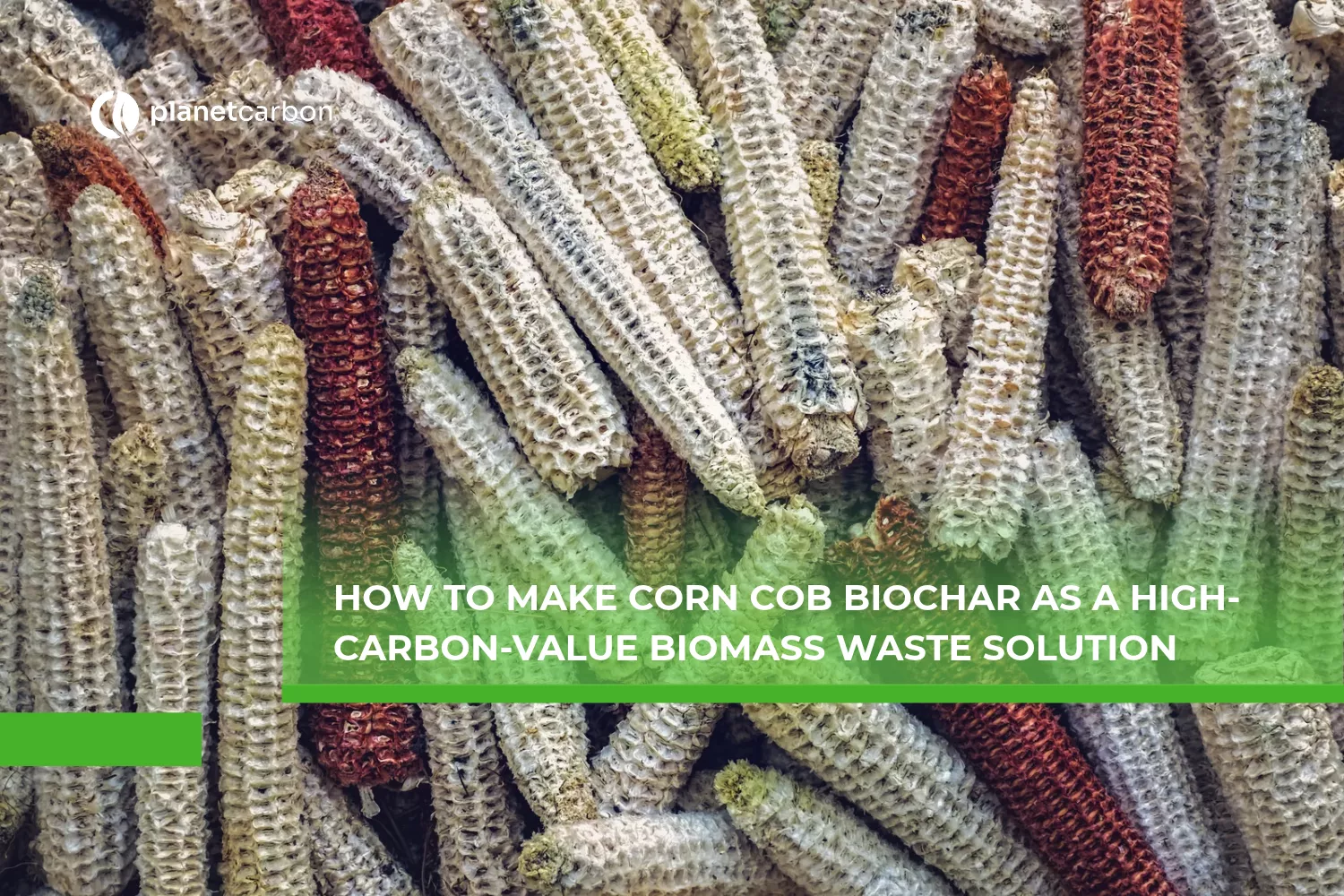
Every corn harvest season, millions of tons of corn cobs are left behind in the field or burned in the open, releasing CO₂ and particulate matter with no economic return for farmers or agribusinesses. In Indonesia alone, corn production exceeded 22 million tons in 2023, meaning the volume of post-harvest residue is significant enough to represent a serious emissions management problem at scale. Yet for most supply chain actors, this waste stream is still treated as a disposal burden rather than a resource.
For agricultural companies and farming cooperatives under growing pressure to meet ESG targets or reduce Scope 3 emissions, this situation represents a missed opportunity with compounding consequences. Disposal costs accumulate season after season, soil organic matter continues to decline, and the carbon embedded in that biomass simply volatilizes into the atmosphere. Neither the farmer nor the agribusiness captures any value from what is essentially a combustible carbon asset.
Corn cob biochar offers a measurable way to break that cycle. By converting corn cob waste through a controlled thermal process called pyrolysis, agricultural stakeholders can produce a stable carbon material that improves soil productivity, reduces net emissions, and qualifies as a fundable carbon removal project under internationally recognized standards. The question is not whether the opportunity exists, but whether the right production and validation process is in place to capture it.
Why is Corn Cob an Excellent Biochar Feedstock?
Corn cobs consistently rank among the most suitable agricultural residues for biochar production, and the reasons go beyond simple availability. Their chemical composition is well-suited to the pyrolysis process: corn cobs typically contain 40 to 45 percent cellulose, around 35 percent hemicellulose, and approximately 15 percent lignin, according to published biomass characterization studies. This lignocellulosic profile translates into stable pyrolysis behavior and predictable carbon yield.
From a carbon quality standpoint, biochar produced from corn cobs tends to achieve a high fixed carbon content, often exceeding 70 percent under slow pyrolysis conditions. This is a critical indicator for carbon permanence, meaning the carbon embedded in the biochar matrix resists decomposition for centuries rather than years. High fixed carbon content is also one of the primary criteria evaluated during the biochar MRV process when a project seeks to issue carbon credits under a recognized international carbon certification standard.
Beyond chemistry, corn cob feedstock is logistically attractive. It is generated in concentrated volumes at mill or processing sites, reducing collection costs compared to dispersed residues like rice straw. For agricultural waste biochar projects intended to scale toward carbon market participation, this feedstock density is an operational advantage that directly affects project economics.
How to Make Corn Cob Biochar
Producing biochar from agricultural waste like corn cobs involves more than simply applying heat to biomass. Each stage of the process has direct implications for product quality, carbon yield, and ultimately the credibility of emissions reduction claims submitted for carbon credit issuance. The four main steps below describe the standard production pathway used in structured biochar projects.
1. Feedstock Collection and Preparation
Corn cobs must be properly collected, sorted, and dried before entering any thermal conversion unit. Moisture content is one of the most critical preparation parameters: feedstock with moisture above 20 percent will consume a disproportionate amount of energy during pyrolysis, reduce the efficiency of the process, and lower the quality of the resulting biochar. Target moisture for most reactor types falls between 10 and 15 percent, achievable through natural sun-drying over two to three days under adequate weather conditions.
Particle size also matters at this stage. Uniformly sized feedstock ensures even heat distribution inside the reactor, which prevents incomplete conversion zones and improves the homogeneity of the final product. For smaller kilns, cobs are often used whole or split; for more industrial systems, they may be pre-chipped or ground to a consistent size before loading.
2. The Pyrolysis Process: The Core of Biochar Production
Pyrolysis is the thermochemical decomposition of organic material in the complete absence of oxygen. When corn cobs are heated to temperatures typically ranging from 350°C to 700°C under oxygen-limited conditions, the volatile compounds in the biomass are driven off as syngas and bio-oil, while the remaining carbon-rich solid becomes biochar. The absence of oxygen is the defining feature that prevents combustion and preserves the carbon structure.
Temperature and residence time are the two most influential variables in determining biochar quality. Slow pyrolysis, conducted at lower temperatures with longer residence times, generally produces higher fixed carbon content and better structural stability. This is the configuration most relevant for projects targeting biochar carbon removal credits, since the carbon quality criteria imposed by recognized standards require demonstrable permanence, not just high yield.
3. Choice of Pyrolysis Technology and Reactor
Several reactor configurations are used commercially and at project scale, each with different trade-offs between capital cost, throughput, and product consistency. Retort kilns are common at small to medium farm or cooperative scale due to their lower upfront cost and ability to recirculate syngas for self-heating. Continuous-feed systems such as rotary kilns or screw reactors offer higher throughput and better process control, making them more suitable for industrial-scale biochar projects targeting verifiable carbon credit output.
The choice of technology also affects MRV integrity. Reactor systems with built-in temperature monitoring, gas capture, and mass flow measurement make it substantially easier to document and verify process parameters, which is a prerequisite for any biochar project aiming to register emissions reductions under a publicly auditable carbon registry. Projects that rely on artisanal or unmonitored kilns face significant verification challenges regardless of biochar quality.
4. Cooling, Grinding, and Storage
Once pyrolysis is complete, biochar must be cooled in a controlled, oxygen-limited environment before exposure to air. Sudden contact with oxygen while the material is still at high temperature can cause partial re-oxidation or even spontaneous combustion, which degrades both quality and safety. A sealed cooling chamber or quench system is the standard approach in structured production facilities.
After cooling, corn cob biochar is typically ground or sieved to the particle size required by its end use, whether as a direct soil amendment, a co-composting input, or a processed product for industrial buyers. Proper sealed storage in dry conditions preserves carbon stability until the material is sampled, tested, and certified. Documentation of each batch at this stage is also the foundation for the chain-of-custody records required by any credible biochar MRV process.
Read Also : The Right Way to Apply Biochar to Crops for Optimal Yields and More Fertile Soil
Biochar Quality Standards to Pay Attention To
Not all biochar qualifies for carbon credit issuance, and the gap between agricultural-grade and credit-eligible biochar comes down to how well the material meets a specific set of measurable criteria. The most widely referenced quality thresholds in the biochar carbon removal market focus on three core parameters: fixed carbon content, hydrogen-to-organic-carbon ratio (H:Corg), and polycyclic aromatic hydrocarbon (PAH) contamination levels.
Fixed carbon content above 70 percent is a commonly applied benchmark for biochar intended to support permanence claims, though different certification frameworks may set slightly different thresholds. The H:Corg ratio is used as a proxy for carbon stability: a lower ratio indicates a more thermally altered, recalcitrant carbon structure that is less susceptible to biological degradation over time. Most recognized international carbon certification standards set an H:Corg threshold at or below 0.7 to qualify for carbon removal credit issuance.
PAH levels are a critical safety parameter, particularly when biochar is applied to agricultural soils. Excessive PAH contamination can present agronomic and regulatory risks that block market access for the biochar as a soil amendment, which would also undermine the project’s land application MRV pathway. Third-party laboratory testing by an accredited independent verification body is the accepted method to confirm that a given batch meets both quality and safety thresholds before any credit claim is submitted.
From Biochar to Carbon Credit: An Often-Overlooked Value-Add Potential
Many agricultural waste biochar projects are conceived purely as soil amendment initiatives, which is a legitimate agronomic goal. However, the potential to generate biochar carbon credits under the voluntary carbon market is frequently underestimated or overlooked, even when the technical conditions are already in place to support it. This oversight represents a real financial gap for project developers who have already invested in production infrastructure.
For a biochar project to generate carbon credits, the emissions reductions or removals must be quantified, reported, and verified according to a methodology approved by a recognized international carbon certification standard. This involves establishing a project boundary, defining a credible baseline scenario, and implementing a monitoring plan that tracks feedstock input, process parameters, and biochar application outcomes. In Indonesia, this framework also intersects with the national carbon market regulatory architecture established under Presidential Regulation No. 110 of 2025 (Perpres 110/2025), which replaced the earlier Perpres 98/2021 and sets the legal basis for carbon economic value (NEK) instruments including emission reduction certificates and carbon credits eligible for trading on an official carbon exchange regulated by the national financial authority.
The MRV requirements for biochar projects are more complex than those for forestry or energy projects, primarily because the carbon permanence claim depends on ongoing soil application records, not just the production event. Despite this complexity, projects that are properly structured from the feedstock stage through to third-party verification can generate revenue from both the agronomic value of the biochar and the carbon credits it produces. For agribusinesses managing large corn processing volumes, biochar carbon removal via the voluntary carbon market represents an incremental revenue stream that can change the economics of waste management at scale.
Schedule a Discussion with the Planet Carbon Team
If you are managing agricultural waste at scale and want to understand whether a corn cob biochar project is viable for your operation, the most useful next step is a structured conversation, not a generic assessment. Planet Carbon works with agricultural stakeholders, cooperatives, and agribusinesses to evaluate feedstock availability, select appropriate pyrolysis technology, design MRV frameworks, and navigate the carbon credit development process from concept to commercialization.
There is no single template for a successful biochar project, because feedstock volumes, land tenure structures, offtake arrangements, and regulatory context all vary. A direct discussion with the Planet Carbon team allows you to pressure-test your assumptions against real project experience before committing resources.
Reach out to the Planet Carbon team to schedule a no-obligation consultation on your agricultural waste biochar project. Whether you are at the feasibility stage or already producing biochar and looking to understand the credit pathway, the conversation is a practical starting point.
Referensi:
- Badan Pusat Statistik (BPS) Indonesia: National corn production data 2023, used as basis for residue volume context – https://www.bps.go.id
- Published biomass characterization studies (general scientific literature): Cellulose, hemicellulose, and lignin composition ranges for corn cob feedstock, supporting the 40-45% cellulose / 35% hemicellulose / 15% lignin figures cited
- Biochar quality criteria (H:Corg ratio, fixed carbon, PAH thresholds): Referenced from general biochar carbon removal methodology literature and recognized international carbon certification standard frameworks
- Peraturan Presiden Nomor 110 Tahun 2025 tentang Nilai Ekonomi Karbon: Legal basis for Indonesia’s national carbon market (NEK) framework, replacing Perpres 98/2021 – https://peraturan.go.id/id/perpres-no-110-tahun-2025
- Science Based Targets initiative (SBTi): Referenced as context for corporate emissions target-setting frameworks relevant to Scope 3 agricultural supply chain emissions – https://sciencebasedtargets.org
- Integrity Council for the Voluntary Carbon Market (ICVCM) / Core Carbon Principles (CCP): Referenced as a framework governing quality standards in the voluntary carbon market – https://icvcm.org
Read Also : How to Make Coconut Shell Biochar for Agricultural Companies and Farmer Cooperatives