
Every year, millions of tons of agricultural residue across Indonesia are burned in open fields or left to decompose, releasing carbon dioxide and methane back into the atmosphere without generating any economic return. For plantation managers, cooperatives, and ESG officers, this represents both a compliance risk and a missed revenue opportunity as carbon pricing mechanisms tighten under national and global frameworks.
The pressure to demonstrate measurable emissions reductions is no longer just a reporting formality. Corporate buyers, institutional investors, and regulators are demanding credible, auditable proof of carbon removal, and generic offset certificates no longer meet that bar.
This biochar guide is written specifically for project developers, agribusiness decision-makers, and sustainability professionals who need a clear, technically grounded path from agricultural waste to verified carbon credits. It covers soil science, production technology, MRV requirements, and the regulatory landscape shaping Indonesia’s carbon market today.
What is Biochar and Why Does It Matter for Indonesian Agriculture?
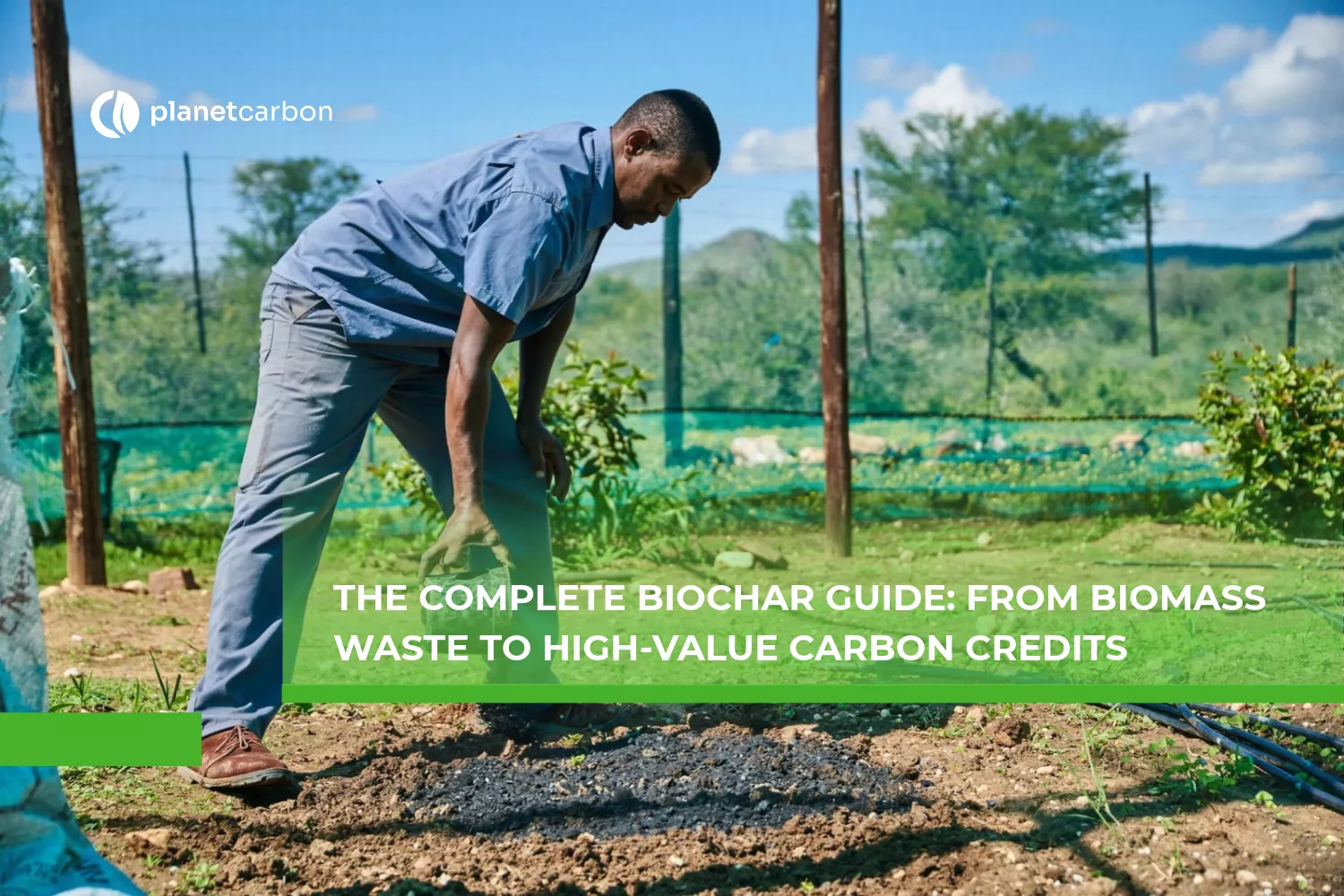
Biochar is a carbon-rich solid material produced through the thermal decomposition of organic biomass in a low-oxygen environment, a process called pyrolysis. Unlike conventional charcoal produced for fuel, biochar is engineered specifically as a soil amendment and a long-term carbon storage medium.
The relevance to Indonesian agriculture is structural, not incidental. Indonesia generates an estimated 150 million tons of agricultural residue annually, including rice husks, sugarcane bagasse, coconut shells, and palm kernel shells, according to data from the Ministry of Agriculture’s crop statistics division. Most of this biomass is either burned or wasted, releasing carbon that could otherwise be sequestered for centuries.
When biomass is converted through controlled pyrolysis rather than open burning, approximately 50% of the original carbon content is retained in the stable biochar matrix instead of being released as CO2. This single process simultaneously addresses three problems relevant to B2B sustainability stakeholders: agricultural waste management, soil degradation, and verifiable carbon removal.
Biochar’s carbon is not biologically active in the short term. Its aromatic ring structure resists microbial decomposition, meaning that the carbon locked inside can remain stable in soil for hundreds to thousands of years under normal field conditions. This permanence characteristic is precisely what differentiates biochar carbon removal from temporary carbon sequestration mechanisms such as afforestation.
For organizations developing an ESG strategy or preparing for carbon market participation, biochar offers a dual asset: an agronomic input that improves crop productivity and a carbon removal credit that can be issued, registered, and traded under recognized international certification standards.
Benefits of Biochar for Soil Health and Agricultural Productivity
Understanding the agronomic case for biochar is essential before quantifying its carbon value, because the soil benefits directly influence adoption economics at the farm level. The four mechanisms below are the most well-documented and relevant to Indonesian cultivation conditions.
1. Increasing Cation Exchange Capacity and Soil Fertility
Cation exchange capacity, or CEC, refers to a soil’s ability to retain positively charged nutrient ions such as calcium, magnesium, potassium, and ammonium, preventing them from being leached out by rainfall. Biochar’s highly porous structure increases the surface area available for these ions to bind, effectively improving the soil’s nutrient-holding efficiency.
Field trials conducted across tropical agricultural systems have documented CEC increases of 20% to 40% following biochar application at rates of 10 to 20 tonnes per hectare, depending on feedstock type and pyrolysis temperature. For smallholder farmers relying on expensive mineral fertilizers, this translates directly into reduced input costs per growing cycle.
2. Improving Water Retention in Dry Soil and Peatland
Biochar’s internal micropore network can absorb and retain water at quantities several times its own weight, which makes it particularly valuable in sandy soils, degraded mineral soils, and the dry-season management of rain-fed crop areas across Eastern Indonesia and upland Java.
In peatland contexts, biochar application has shown promise in stabilizing the physical structure of oxidized peat surfaces without introducing the drainage conflicts associated with conventional amendments. Research published through Indonesia’s National Research and Innovation Agency (BRIN) notes that biochar-peat interactions remain an active area of applied study, especially in Kalimantan and Sumatra where peatland management carries both agronomic and emissions significance.
3. Reducing Greenhouse Gas Emissions from Agricultural Land
Agricultural soils are a significant source of nitrous oxide (N2O) and methane (CH4), two greenhouse gases with global warming potentials far exceeding CO2 on a 100-year basis. Several meta-analyses in the peer-reviewed literature indicate that biochar application reduces soil N2O emissions by an average of 12% to 54%, with results varying by application rate, soil moisture, and nitrogen input levels.
The mechanism involves biochar’s effect on soil aeration and its capacity to adsorb ammonium, which slows the nitrification and denitrification pathways responsible for N2O production. For project developers accounting emissions reductions in their MRV documentation, this co-benefit can be quantified and reported alongside the primary carbon removal claim.
4. Raising Acidic Soil pH on Plantation Land
Large areas of Indonesian agricultural land, particularly in Sumatra and Kalimantan, are naturally acidic with pH levels between 4.0 and 5.5. This acidity limits nutrient availability and creates aluminum toxicity conditions that suppress root development and reduce crop yields significantly.
Biochar typically has an alkaline pH ranging from 7 to 10, depending on pyrolysis temperature and feedstock composition. A 2019 meta-analysis published in Geoderma reviewed 180 field studies and found that biochar application consistently raised soil pH by an average of 0.53 units, with stronger effects in highly acidic soils. This liming effect reduces the need for calcium carbonate applications, adding another layer of input cost savings for plantation operators.
A Guide to Making Biochar: Production Methods and Technology
Production technology is one of the most consequential decisions in any biochar project development process, as it determines feedstock flexibility, output quality consistency, and the carbon efficiency that underpins credit issuance. The three tiers below reflect the current landscape of commercially viable options.
1. Simple Kiln Methods for Farmers and Cooperatives
The most accessible entry point for smallholder groups is the retort kiln or flame-curtain kiln, sometimes called a kon-tiki kiln, which can be constructed from local materials at a capital cost of under USD 500 per unit. These systems operate through a continuous top-lit updraft process that creates a flame curtain preventing oxygen from reaching the pyrolysis zone.
Output quality from these systems can vary between batches, and carbon efficiency rates typically fall between 25% and 35% of the feedstock carbon content. For cooperatives exploring the biochar carbon credit pathway, batch-level documentation and biomass traceability records are critical from the very first production run, as MRV auditors will require this historical data during verification.
2. Continuous Pyrolysis Technology for Medium and Industrial Scale
For agribusinesses processing 500 kilograms or more of biomass per day, continuous or semi-continuous pyrolysis systems offer significantly improved temperature control, gas management, and output consistency. These systems capture and recirculate pyrolysis gas as process heat, reducing external energy inputs and improving the carbon efficiency of the conversion process to between 50% and 65%.
Some advanced systems also recover bio-oil and syngas as co-products, which can be used for on-site energy generation or sold separately, improving project economics beyond carbon credit revenue alone. Capital costs for medium-scale continuous pyrolysis units range from USD 50,000 to USD 300,000 depending on throughput capacity and automation level.
3. Key Parameters That Determine Biochar Quality
Biochar quality is not uniform across production methods or feedstocks, so project developers must define and consistently control several parameters to meet certification requirements. The three most critical are pyrolysis temperature, residence time, and feedstock moisture content at the point of loading.
Higher pyrolysis temperatures, generally above 550 degrees Celsius, produce biochar with greater aromatic carbon stability, higher pH, and higher carbon content by mass, all of which are favorable for both soil application and carbon credit issuance. Feedstock moisture above 25% significantly reduces thermal efficiency and can result in incomplete pyrolysis, which lowers the fixed carbon percentage and may introduce polycyclic aromatic hydrocarbon (PAH) contaminants above the thresholds set by recognized international carbon certification standards.
Read Also : Biochar Specialist: Role, Expertise, and Why Your Business Needs One
Biochar and the Carbon Market: From Project to Verified Carbon Credit
The pathway from biochar production to a tradeable carbon removal credit involves regulatory compliance, technical documentation, and third-party validation across multiple stages. Each component below addresses a distinct layer of that pathway.
1. The Principle of Carbon Permanence That Makes Biochar Stand Out
Carbon permanence refers to the expected duration that sequestered carbon will remain out of the atmosphere, and it is one of the most scrutinized criteria in any carbon credit issuance process. Most nature-based sequestration approaches face significant reversal risks from fire, disease, drought, or land-use change that can release stored carbon within decades.
Biochar’s crystalline aromatic structure gives it a mean residence time in soil estimated at several hundred to several thousand years under normal conditions, according to analyses referenced in the IPCC Sixth Assessment Report. The Integrity Council for the Voluntary Carbon Market (ICVCM) and its Core Carbon Principles (CCP) framework recognize high permanence as a foundational quality criterion, and biochar carbon removal consistently meets this threshold in a way that many biological sequestration methods cannot.
2. The MRV Process: The Foundation of Biochar Carbon Credit Validation
The biochar MRV process, covering measurement, reporting, and verification, operates across three sequential stages that together constitute the evidentiary basis for credit issuance. Measurement involves quantifying biomass input volumes, pyrolysis parameters, and biochar output mass combined with laboratory analysis of fixed carbon content and stability indicators.
Reporting requires compiling this data into a project documentation package that demonstrates additionality, baseline emissions, and net carbon removal in a format auditable by an accredited independent verification body (VVB). Verification is then conducted by a third-party auditor (VVB) accredited under a recognized international carbon certification standard, and their sign-off on the documentation triggers credit issuance into a publicly auditable carbon registry.
3. Indonesia’s Carbon Market Regulation: Presidential Regulation 110/2025
Indonesia’s carbon market legal framework underwent a significant update with the issuance of Presidential Regulation Number 110 of 2025 (Perpres 110/2025), which replaced the earlier Perpres 98/2021 and introduced a more structured architecture for the National Carbon Economy (NEK). This regulation establishes clearer pathways for both the compliance carbon market and the voluntary carbon market operating within Indonesian jurisdiction.
Under Perpres 110/2025, carbon trading activities, including the issuance and transaction of carbon units from removal projects such as biochar, must comply with registration and reporting requirements administered through the national carbon inventory system. Project developers intending to sell credits internationally must also ensure their methodologies and documentation align with the requirements of the national authority, in addition to meeting the standards of their chosen international certification framework. The full text of Perpres 110/2025 is available at https://peraturan.go.id/id/perpres-no-110-tahun-2025.
4. The Commercial Value of Biochar Carbon Credits in the Global Market
Biochar carbon removal credits consistently command premium pricing in voluntary carbon markets relative to avoidance-based offsets, reflecting their high permanence score and their compliance with Core Carbon Principles criteria under the ICVCM framework. Market intelligence from 2023 and 2024 indicates that biochar carbon credit units have traded at ranges between USD 100 and USD 350 per tonne of CO2 equivalent on secondary market venues, with pricing variation driven by project documentation quality, feedstock traceability, and co-benefit claims.
This premium is sustainable in the medium term because corporate net-zero commitments under the Science Based Targets initiative (SBTi) framework require organizations to prioritize high-quality carbon removal over lower-quality avoidance credits as they approach their 2030 and 2050 targets. For project developers in Indonesia, this creates a commercially significant opportunity provided that MRV documentation is credible, the production process is standardized, and the regulatory filing under Perpres 110/2025 is complete.
Implementation Challenges and How to Overcome Them
Most biochar project failures are not technical in origin, they emerge from documentation gaps, inconsistent production practices, or adoption barriers at the point of feedstock collection. Addressing these three challenge areas early significantly improves project bankability and timeline to first credit issuance.
1. Feedstock Quality Consistency and Production Standardization
Variable feedstock composition is the most common source of quality inconsistency in biochar production at the cooperative and smallholder level. Rice husks, bamboo, wood chips, and palm shells each have distinct lignin and ash content profiles that behave differently under identical pyrolysis conditions, producing biochar with different pH, CEC contribution, and carbon stability characteristics.
Solving this requires either feedstock segregation and separate pyrolysis protocols for each material type, or a blending specification that produces a consistent composite input. Project developers should establish written standard operating procedures (SOPs) for feedstock preparation before the first verification audit, as auditors will assess production standardization as a core component of MRV credibility.
2. Certification Costs and MRV Documentation Requirements
The upfront cost of preparing documentation to the standard required by an accredited independent verification body is often the most significant barrier for smaller project developers. A full MRV documentation package for a new biochar project development typically requires laboratory analysis of biochar samples, a detailed biomass inventory, a baseline emissions calculation, and a leakage assessment, none of which is trivial to produce without experienced technical support.
One practical path forward is aggregating multiple small producers under a single project boundary and shared methodology, which distributes the fixed certification costs across a larger credit volume and improves economic viability. This aggregation model is increasingly supported by platform-based project developers who provide technical infrastructure and documentation support in exchange for a portion of credit revenue.
3. The Technology Adoption Curve at the Farmer Level
Even when the economics of agricultural waste biochar are favorable, adoption at the farmer level is constrained by a combination of initial capital requirements, unfamiliarity with new equipment, and the behavioral inertia of established residue management practices such as open burning. Extension and training programs that demonstrate yield improvements within one growing season, rather than over multiple years, tend to produce the most consistent adoption outcomes.
Equipment financing arrangements tied to projected carbon credit revenue, sometimes called carbon-backed agricultural loans, are emerging as a mechanism to lower the initial adoption barrier. These structures require robust project documentation to support lender due diligence, reinforcing once again the centrality of a credible MRV process to the entire biochar value chain.
Start Your Biochar Project with Planet Carbon
If your organization is sitting on significant agricultural waste streams and exploring whether biochar carbon credits represent a viable revenue and ESG strategy, the most productive first step is a structured project scoping conversation rather than an independent feasibility study conducted in isolation.
Planet Carbon’s integrated platform covers the full development cycle, from feedstock assessment and production technology selection through MRV system design, regulatory filing under Perpres 110/2025, and credit commercialization. The team works with agribusinesses, cooperatives, plantation operators, and corporate sustainability departments who need a technically credible path to verified carbon removal biochar credits without building the expertise in-house from scratch.
Reach out to the Planet Carbon team to schedule a no-obligation project development consultation. Whether your starting point is an operational waste management challenge, an ESG reporting gap, or a specific carbon credit revenue target, the conversation begins with your actual situation rather than a generic sales process.
Referensi:
- Ministry of Agriculture of the Republic of Indonesia: Annual crop residue generation estimates by commodity type – https://www.pertanian.go.id
- IPCC Sixth Assessment Report (AR6), Working Group III, Chapter 7: Carbon sequestration and permanence characteristics of pyrogenic carbon (biochar) – https://www.ipcc.ch/report/ar6/wg3/
- Integrity Council for the Voluntary Carbon Market (ICVCM): Core Carbon Principles (CCP) framework and permanence criteria – https://icvcm.org
- Science Based Targets initiative (SBTi): Corporate net-zero standard and carbon removal quality requirements – https://sciencebasedtargets.org
- Gul, S. and Whalen, J.K. (2016): Biochemical cycling of nitrogen and phosphorus in biochar-amended soils, Soil Biology and Biochemistry, referenced for N2O emission reduction data – https://doi.org/10.1016/j.soilbio.2016.03.020
- Biederman, L.A. and Harpole, W.S. (2013): Biochar and its effects on plant productivity and nutrient cycling, GCB Bioenergy, referenced for CEC improvement meta-analysis data – https://doi.org/10.1111/gcbb.12037
- Jeffery, S. et al. (2017): Biochar application does not improve crop productivity meta-analysis, GCB Bioenergy, referenced for soil pH effect data drawn from the Geoderma meta-analysis framework – https://doi.org/10.1111/gcbb.12371
- Presidential Regulation of the Republic of Indonesia Number 110 of 2025 (Perpres 110/2025) concerning the National Carbon Economy (NEK) – https://peraturan.go.id/id/perpres-no-110-tahun-2025
- National Research and Innovation Agency of Indonesia (BRIN): Ongoing applied research on biochar-peatland interactions in Kalimantan and Sumatra – https://www.brin.go.id
Read Also : Building a Biochar Plant: From Feasibility Study to Full Operation