
Construction is responsible for roughly 37% of global energy-related CO₂ emissions, and concrete alone accounts for about 8% of annual global carbon output (IEA, 2023). For corporate buyers with net-zero commitments and ESG obligations to institutional stakeholders, the materials embedded in their supply chains are no longer a background detail.
At the same time, the voluntary carbon market is under growing pressure to move away from avoidance-based credits toward durable, measurable carbon removal. Buyers and traders who have staked portfolio credibility on low-quality offsets are now facing scrutiny from the Science Based Targets initiative (SBTi) and the Integrity Council for the Voluntary Carbon Market (ICVCM), both of which have raised the bar on what counts as a credible carbon credit.
Biochar concrete offers a convergence point that few materials can match: it physically sequesters carbon inside the built environment for hundreds to thousands of years, it is derived from agricultural biomass waste that would otherwise decompose or burn, and it generates carbon credits that meet internationally recognized certification standards. Understanding how this material works is increasingly relevant for anyone purchasing or trading high-integrity carbon credits.
What is Biochar in Concrete?
Biochar is a stable, carbon-rich material produced through pyrolysis, a thermochemical process in which organic biomass is heated at high temperatures in a low-oxygen environment. The feedstock is typically agricultural waste such as rice husks, sugarcane bagasse, or crop residues that would otherwise release CO₂ through decomposition or open burning. Rather than returning that carbon to the atmosphere, the pyrolysis process locks it into a solid, porous matrix with a half-life measured in centuries.
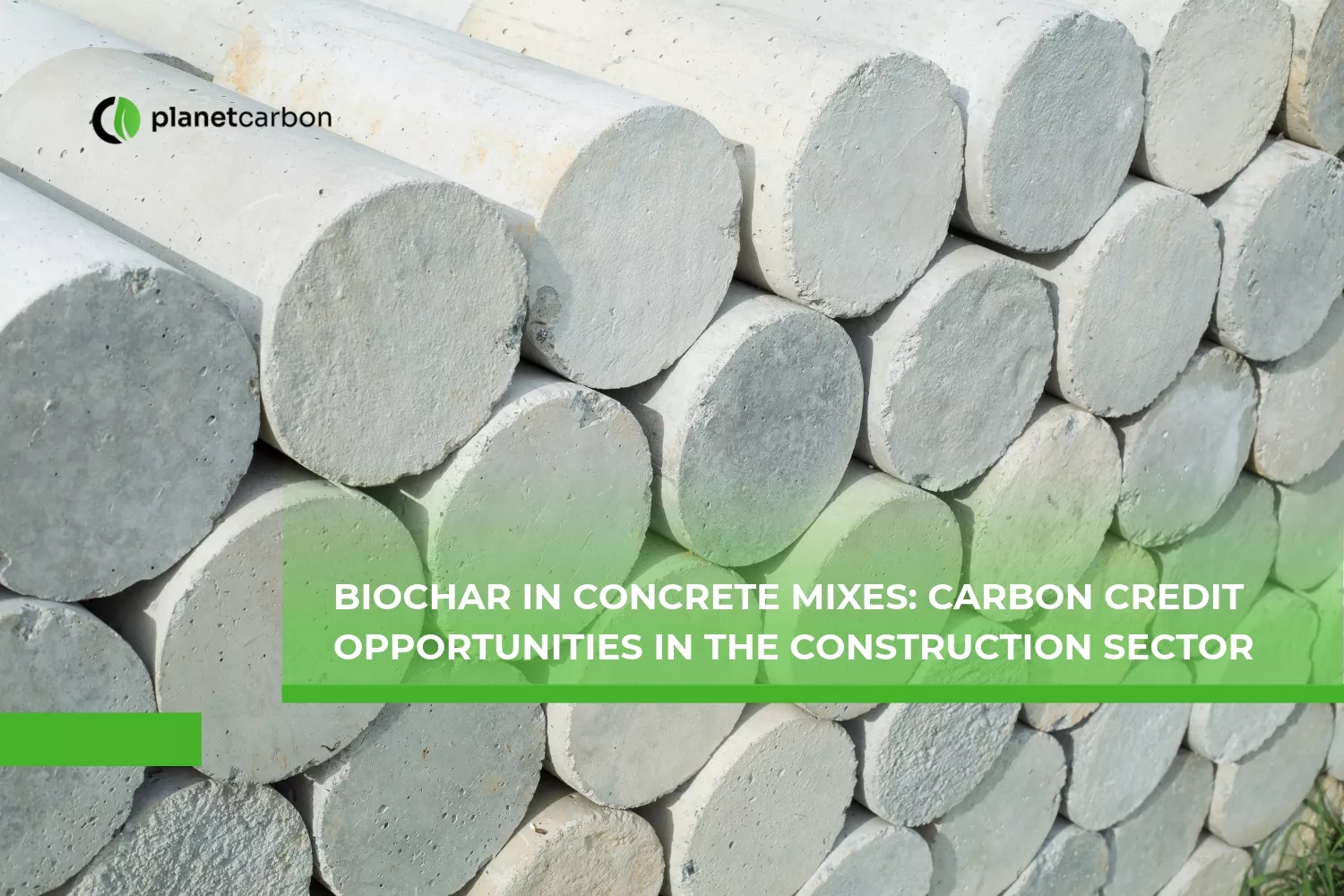
When biochar is incorporated into concrete mixes, typically replacing a portion of cement or fine aggregate at rates between 1% and 10% by weight, it brings the sequestered carbon directly into the structural built environment. The carbon does not merely offset emissions elsewhere in a supply chain; it is physically embedded in the material itself. This distinction matters considerably for buyers evaluating the permanence and additionality of carbon removal claims.
Biochar in cement applications are gaining traction precisely because construction assets have long service lives. A biochar-bearing structural element in a commercial building, a bridge, or an infrastructure project can reasonably lock in that carbon for 50 to 100 years or more, aligning the sequestration timeline with the durability expectations of the asset itself.
Why Is Biochar Concrete Relevant for Carbon Credit Buyers?
The carbon market is entering a phase where credit quality is no longer a secondary consideration. The ICVCM’s Core Carbon Principles (CCP) framework and SBTi guidance have both moved to distinguish between credits that avoid or reduce emissions and credits that physically remove carbon from the atmosphere. Biochar-based removal credits fall into the latter category, and this matters for portfolio construction.
Corporate buyers operating under Science Based Targets guidance are increasingly required to pair residual emissions reductions with high-quality carbon dioxide removal, not merely avoidance credits. Biochar concrete projects, when properly documented and verified, can generate permanent carbon removal credits recognized under a recognized international carbon certification standard. For traders and corporate sustainability teams building long-dated offset positions, this represents an asset class with structural demand support.
There is also a regulatory dimension worth noting for buyers active in or adjacent to the Indonesian market. Presidential Regulation No. 110 of 2025 (Perpres 110/2025), which replaced the earlier Perpres 98/2021, provides the current legal framework governing Indonesia’s carbon economic value (NEK) system. Projects that generate biochar carbon credits under this framework must meet MRV requirements consistent with the national Carbon Registry, and high-quality removal-based projects are positioned favorably as that system matures.
Read Also : Sugarcane Bagasse Biochar: Sustainable Carbon and Agriculture Solutions for the Sugar Industry
Technical Properties of Biochar in Concrete Mixes
The performance case for biochar concrete rests on three interconnected material properties, each of which carries implications for both structural application and carbon accounting. Together, these properties determine whether a given biochar-concrete formulation can be certified under a recognized international carbon certification standard while still meeting engineering requirements.
1. Effect on Compressive Strength
At low substitution rates, typically under 5% replacement of cement or fine aggregate, studies have reported compressive strength outcomes that are comparable to or marginally below standard concrete mixes (Gupta et al., 2021). The porosity and surface chemistry of biochar affect the hydration dynamics of the cement matrix, so feedstock quality and particle size distribution are material variables.
At higher substitution rates, strength reduction becomes more pronounced, which is why most current applications position biochar as a partial admixture rather than a bulk replacement. The trade-off is manageable in non-structural or lightly loaded applications, and ongoing research is improving formulation techniques to close the performance gap in structural-grade contexts.
2. Porosity and Water Management
Biochar’s inherently porous microstructure introduces a water retention and internal curing function within the concrete matrix. This can be beneficial in hot or arid climates where early-age moisture loss accelerates shrinkage cracking, a common durability concern in tropical construction environments. For projects in Southeast Asia, where heat and humidity create variable curing conditions, this property has practical relevance beyond carbon accounting.
The same porosity also affects chloride ion permeability and, consequently, long-term corrosion resistance in reinforced concrete. Research results here are mixed and depend heavily on the pre-treatment and saturation state of the biochar prior to mixing. A rigorous biochar MRV process should account for these material characteristics when establishing permanence claims.
3. Compatibility with Other Materials
Agricultural waste biochar sourced from different feedstocks carries varying ash content, pH levels, and volatile matter concentrations, all of which interact with supplementary cementitious materials such as fly ash or ground granulated blast furnace slag. Compatibility testing at the formulation stage is therefore not optional; it is a precondition for consistent performance and credible carbon accounting.
Standardized pre-treatment protocols, including washing, pyrolysis temperature control, and particle sizing, significantly reduce variability across batches. Projects intending to generate permanent carbon removal credits under a publicly auditable carbon registry will need to demonstrate feedstock consistency as part of their MRV documentation, making upstream quality control an integral part of the carbon credit value chain.
Carbon Credit Potential from Biochar Concrete Projects
The carbon credit case for biochar concrete rests on permanence, measurability, and additionality, three criteria that high-integrity carbon markets now treat as non-negotiable. When biomass that would otherwise decompose is converted into biochar and incorporated into a long-lived concrete structure, the sequestered carbon is removed from the biogenic cycle for the service life of that structure and beyond. A properly designed biochar MRV process can quantify that removal at the batch level, linking production records to verified carbon stocks.
Carbon removal credits generated from biochar concrete projects typically follow a lifecycle boundary that begins at feedstock procurement and ends at permanent incorporation into the structure. The MRV methodology must account for pyrolysis emissions, transport, and concrete batching energy use as contra-entries, with the net sequestration figure forming the basis for credit issuance. Projects seeking recognition under a recognized international carbon certification standard will generally require third-party validation by an accredited independent verification body before credits can be issued and listed on a publicly auditable carbon registry.
For construction-sector buyers, the practical opportunity is to embed carbon credit generation directly into materials procurement. Rather than purchasing offsets separately from a secondary market venue and hoping they survive scrutiny, project developers can integrate biochar concrete from the design stage, creating a documented carbon removal claim that is tied to a physical asset. This structural alignment between the carbon claim and the built asset is what makes carbon negative construction a commercially defensible narrative rather than a marketing position.
Biochar Concrete as a Long-Term Carbon Removal Instrument in Your Portfolio
High-integrity carbon removal credits are increasingly being treated as a distinct asset class within corporate decarbonization portfolios, separate from avoidance-based offsets and subject to different discount rates when assessed against SBTi or ICVCM frameworks. Biochar concrete projects, with their verifiable permanence profiles and agricultural waste feedstock chains, are well suited to anchor the removal tier of a diversified credit portfolio.
For institutional buyers, the long-dated permanence of biochar embedded in concrete infrastructure also addresses a concern that is becoming more prominent in sustainability reporting: whether a carbon removal claim will hold up over the full period of a net-zero commitment. A credit backed by biochar locked into a 50-year infrastructure asset presents a different risk profile than a forestry credit subject to reversal events.
The convergence of tightening carbon market standards, growing demand for ESG construction materials, and improving biochar concrete formulation science is creating a commercial window that has not previously existed at scale. Buyers who position early in this market, by incorporating biochar concrete into procurement frameworks and securing removal credits through a recognized international carbon certification standard, are likely to find both regulatory and reputational advantages as the carbon market continues to mature.
Discuss Biochar Concrete Opportunities with the Planet Carbon Team
If you are evaluating how biochar concrete fits into your carbon credit portfolio or your organization’s construction procurement strategy, the specifics matter considerably. Feedstock sourcing, MRV methodology, credit certification pathways, and structural engineering compatibility all interact in ways that are difficult to assess from a distance.
The Planet Carbon team works across the full cycle of biochar carbon projects, from project development and validation through to commercialization. If you would like to explore what a biochar concrete project could look like within your supply chain or credit portfolio, we are happy to work through the details with you.
Reach out to the Planet Carbon team to schedule a working discussion. No obligation, just a practical conversation about what the numbers and the methodology actually look like for your specific context.
Referensi:
- International Energy Agency (IEA): Global construction sector emissions data, citing construction as responsible for approximately 37% of energy-related CO₂ emissions and concrete for approximately 8% of annual global carbon output – https://www.iea.org/reports/tracking-clean-energy-progress-2023
- Gupta, S. et al. (2021): Research on compressive strength outcomes of biochar-cement composites at varying substitution rates – https://www.sciencedirect.com/science/article/pii/S221450952400010X
- Science Based Targets initiative (SBTi): Guidance on corporate net-zero targets and carbon dioxide removal requirements – https://sciencebasedtargets.org
- Integrity Council for the Voluntary Carbon Market (ICVCM): Core Carbon Principles (CCP) framework for high-integrity carbon credit assessment – https://icvcm.org
- Peraturan Presiden Nomor 110 Tahun 2025 (Perpres 110/2025): Indonesia’s legal framework for carbon economic value (NEK), replacing Perpres 98/2021 – https://peraturan.go.id/id/perpres-no-110-tahun-2025
Read Also : Coffee and Cocoa Husk Waste Turned into Carbon-Valuable Biochar