
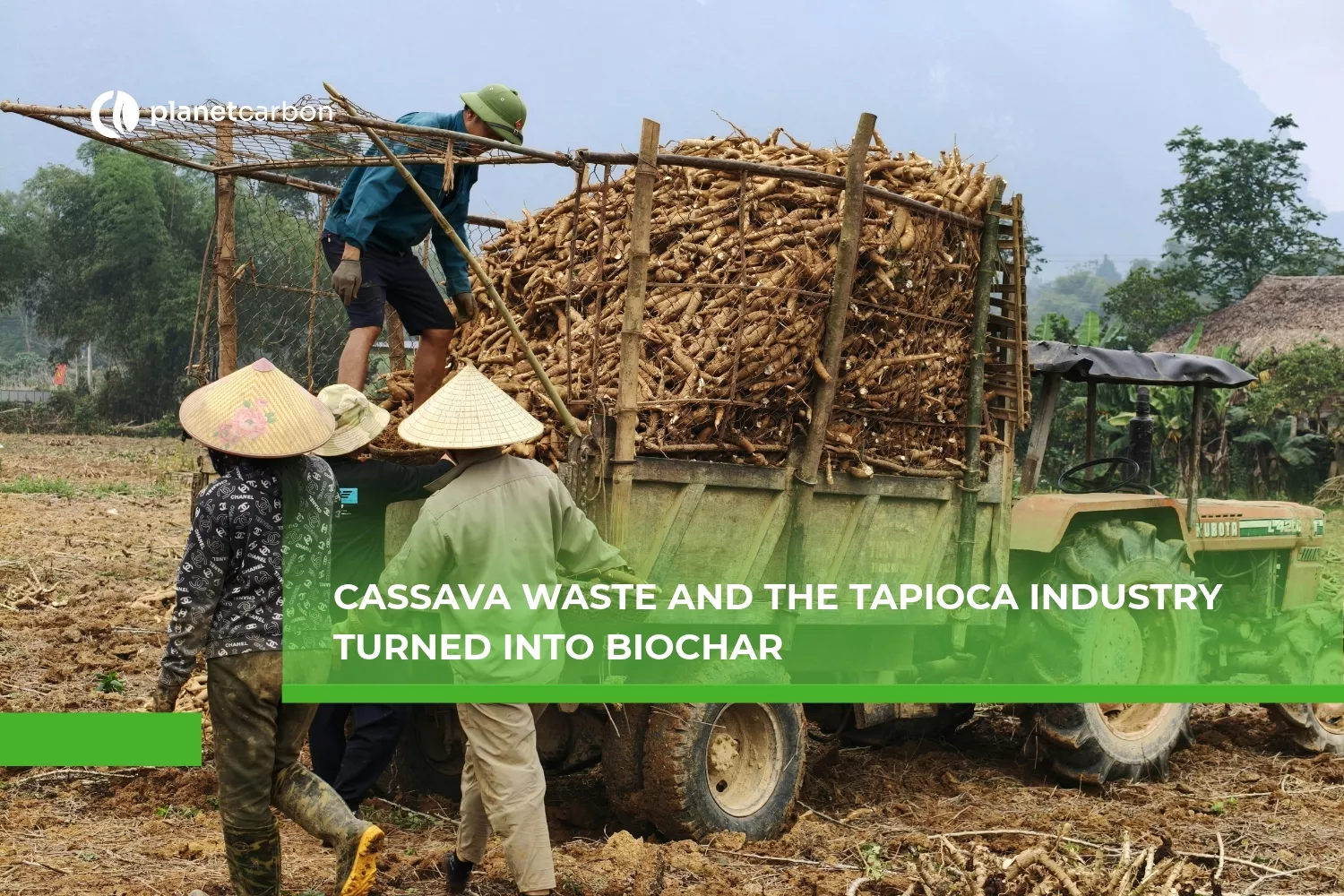
For cassava-processing facilities and plantation operators, agricultural residue disposal is a persistent operational headache. Cassava peels, stems, and bagasse accumulate in large volumes at every stage of tapioca production, and most facilities either burn them openly or leave them to decompose, both of which release stored carbon back into the atmosphere and contribute directly to scope 1 emissions.
As ESG scrutiny intensifies and carbon compliance costs rise across Southeast Asia, leaving this biomass untreated is no longer just a waste management issue. It has become a missed financial opportunity and a growing liability, particularly for agribusinesses beginning to face pressure from corporate buyers, institutional investors, and national regulatory frameworks that now assign a measurable cost to unchecked emissions.
Cassava waste biochar offers a concrete, scalable pathway out of this problem. By converting cassava residue through controlled pyrolysis, agribusinesses can lock away carbon for centuries, generate a soil amendment that measurably improves farmland productivity, and produce verified carbon credits that are tradeable on both voluntary and compliance carbon markets.
Why Is Cassava Waste Suitable as a Biochar Feedstock?
Not all agricultural residues make equally viable biochar feedstocks, and cassava biomass stands out on several practical dimensions. Understanding those characteristics is the first step toward assessing whether your facility has the volume and material quality needed to build a credible project.
1. Ideal Biomass Characteristics
Cassava peels and stems carry a lignocellulosic structure with relatively high cellulose and lignin content, which makes them thermally stable during pyrolysis and yields a biochar with strong carbon retention properties. Research published in Processes (MDPI, 2025) indicates that cassava-derived biochar can achieve a fixed carbon content exceeding 60 percent when pyrolysis temperature and residence time are properly controlled, a threshold that matters directly for carbon credit quantification under recognized international carbon certification standards.
The low ash content typical of cassava peel further reduces the risk of clinker formation during thermal conversion, keeping equipment fouling manageable and conversion efficiency high. This translates to lower operational disruption and more predictable output quality across production batches.
2. Significant Waste Volume
Indonesia is the world’s third-largest cassava producer, generating an estimated 19 to 20 million tonnes of fresh root per year. Because cassava peel alone accounts for roughly 16 to 20 percent of total tuber weight, a mid-scale tapioca processing plant handling 100 tonnes of root per day can produce upward of 16 to 20 tonnes of peel daily, before accounting for bagasse and stems.
At that throughput, the feedstock base is not marginal. It is large enough to anchor a dedicated pyrolysis unit and generate a carbon removal volume that justifies third-party MRV investment, which is the minimum commercial threshold for entering a publicly auditable carbon registry.
From Tapioca Waste to Standardized Biochar
Converting cassava residue into market-ready biochar is not a single-step operation. The process involves several sequential stages, each of which affects the final product’s carbon stability, agronomic performance, and ultimately its eligibility for carbon credit issuance.
1. Feedstock Preparation Stage
Cassava peel and bagasse typically arrive at the processing point with moisture content ranging from 60 to 80 percent, which is far too high for efficient pyrolysis. Drying is therefore the first operational priority, and facilities generally use passive solar drying, rotary drum dryers, or waste-heat recovery from the pyrolysis unit itself to bring moisture below 15 to 20 percent before the material enters the kiln.
Size reduction through shredding or chipping follows drying and ensures uniform particle distribution inside the reactor, because uneven feedstock size leads to inconsistent heat penetration and variable char quality. Standardizing this upstream step is often what separates a pilot-scale experiment from a commercially repeatable production run.
2. Pyrolysis as the Core of the Process
Cassava peel pyrolysis typically operates in a temperature range of 400 to 700 degrees Celsius under limited or zero oxygen conditions. Lower temperatures in this range tend to preserve more volatile compounds and produce a biochar with higher cation exchange capacity, which is beneficial for soil application. Higher temperatures push fixed carbon content upward, which is advantageous for carbon sequestration accounting and credit issuance.
The choice between batch kilns, continuous screw reactors, or retort systems depends on available capital, feedstock volume, and whether co-products such as syngas or bio-oil are intended for energy recovery. For carbon credit purposes, the pyrolysis process must be fully documented and auditable, so equipment choice affects not only yield but also the data trail required by the biochar MRV process.
3. Output Quality Control
After cooling, cassava waste biochar is tested against a set of physicochemical parameters including H/C ratio, pH, surface area, and contaminant thresholds. An H/C molar ratio below 0.7 is the widely cited benchmark for confirming long-term carbon stability, because it indicates that the organic carbon structure has been sufficiently aromatized to resist biological decomposition over centuries rather than years.
Batch records, feedstock traceability logs, and laboratory certificates form the documentary backbone of any subsequent MRV audit. Without this quality control infrastructure in place, biochar produced from cassava biomass carbon removal cannot be credibly submitted for third-party verification, regardless of how well the pyrolysis itself performed.
Read Also : Coffee and Cocoa Husk Waste Turned into Carbon-Valuable Biochar
The Dual Value of Biochar from the Tapioca Industry: Soil Improvement and Carbon Credits
The commercial case for converting tapioca waste into biochar rests on two independent but reinforcing value streams. Both can be pursued simultaneously, and the most financially resilient projects are typically those that capture revenue from both sides rather than treating one as secondary.
1. Agronomic Benefits for Agricultural Land
Biochar applied to tropical soils with characteristically low organic matter and high acidity can measurably improve cation exchange capacity, water retention, and microbial activity. Field trials conducted on Indonesian agricultural soils show that biochar amendment at rates of five to ten tonnes per hectare increases crop yield by 10 to 30 percent in the first two seasons, particularly for upland crops grown on ultisols and oxisols where nutrient leaching is chronic.
For tapioca producers who own or contract adjacent plantation land, this creates a circular economy dynamic: the residue from processing returns to the field as a soil input that reduces fertilizer dependency and improves the productivity of the next cassava crop. This agronomic loop is also increasingly attractive to downstream buyers who require suppliers to demonstrate quantifiable scope 3 emission reductions across the agricultural supply chain.
2. Verified Carbon Credit Potential
Each tonne of stable carbon locked into biochar and applied to soil represents a measurable carbon removal unit. Under a recognized international carbon certification standard, that removal can be quantified, verified by an accredited independent verification body, and issued as a tradeable carbon credit on a publicly auditable carbon registry.
Biochar carbon credits derived from biomass residue feedstocks like cassava peel are increasingly positioned as high-permanence, high-additionality assets, meaning they satisfy the more stringent due diligence criteria now applied by corporate buyers aligned with the Core Carbon Principles (CCP) framework of the Integrity Council for the Voluntary Carbon Market (ICVCM). For agribusinesses looking to monetize their waste stream while building a credible carbon portfolio, this is a structurally sound entry point into the voluntary carbon market biochar segment.
3. Relevance to Indonesia’s Carbon Regulations
Indonesia’s carbon market regulatory framework underwent a significant update with the issuance of Presidential Regulation No. 110 of 2025 (Perpres 110/2025), which replaced the earlier Perpres 98/2021 and introduced a more structured mechanism for carbon economic value (NEK) implementation. Under this framework, biochar projects grounded in cassava biomass carbon removal and documented through a rigorous biochar MRV process can qualify for participation in Indonesia’s developing compliance market, in addition to the voluntary market.
Agribusinesses that establish their measurement, reporting, and verification infrastructure now are better positioned to transition into compliance-grade credit issuance as national carbon pricing mechanisms mature. The regulatory direction is clear, and the cost of building that infrastructure increases the longer a facility waits.
Operational Challenges to Understand from the Start
Entering the cassava waste biochar value chain is commercially viable, but it is not without friction points that operators need to anticipate before committing capital.
Feedstock seasonality is the first structural constraint. Cassava processing volumes fluctuate with harvest cycles, which means pyrolysis units may face inconsistent feedstock supply during off-peak months. Facilities that can aggregate residue from multiple processing sites or blend cassava biomass with other compatible agricultural residues tend to achieve more stable annual throughput and more bankable MRV data.
MRV documentation requirements represent the second major operational investment. Obtaining carbon credits is not simply a matter of producing biochar. It requires continuous data logging of feedstock inputs, process parameters, and application records, all traceable to specific project boundaries and verifiable by an accredited third-party auditor (VVB). Operators who underestimate this administrative burden often find their first verification cycle significantly more expensive and slower than projected.
Finally, off-take agreements for both the biochar product and the resulting carbon credits need to be structured early in project development. Agronomic buyers, soil amendment distributors, and carbon credit purchasers operate on different procurement cycles and due diligence timelines, and a project that lacks committed off-take on at least one side of the value equation will struggle to secure project financing on competitive terms.
Start Calculating Your Biomass Potential with the Planet Carbon Team
If your facility processes cassava at meaningful scale, the residue volume you generate each week may already be sufficient to anchor a commercially viable biochar carbon removal project. The variables that matter most, including feedstock moisture, annual throughput, land application area, and regulatory eligibility under Perpres 110/2025, are all quantifiable with the right framework.
The Planet Carbon team works with agribusinesses and plantation operators across the biomass supply chain to assess project feasibility, structure MRV documentation, and develop a commercialization pathway that connects cassava waste biochar production to verified carbon credit markets. If you want to understand what your biomass stream is actually worth before committing to any infrastructure decision, a technical discussion with our team is a practical place to start.
Reach out to explore a biomass supply partnership or request a preliminary feedstock assessment.
Referensi:
- MDPI, Processes (2025): Fixed carbon content and physicochemical properties of cassava-derived biochar under
Read Also : Biochar in Concrete Mixes: Carbon Credit Opportunities in the Construction Sector