
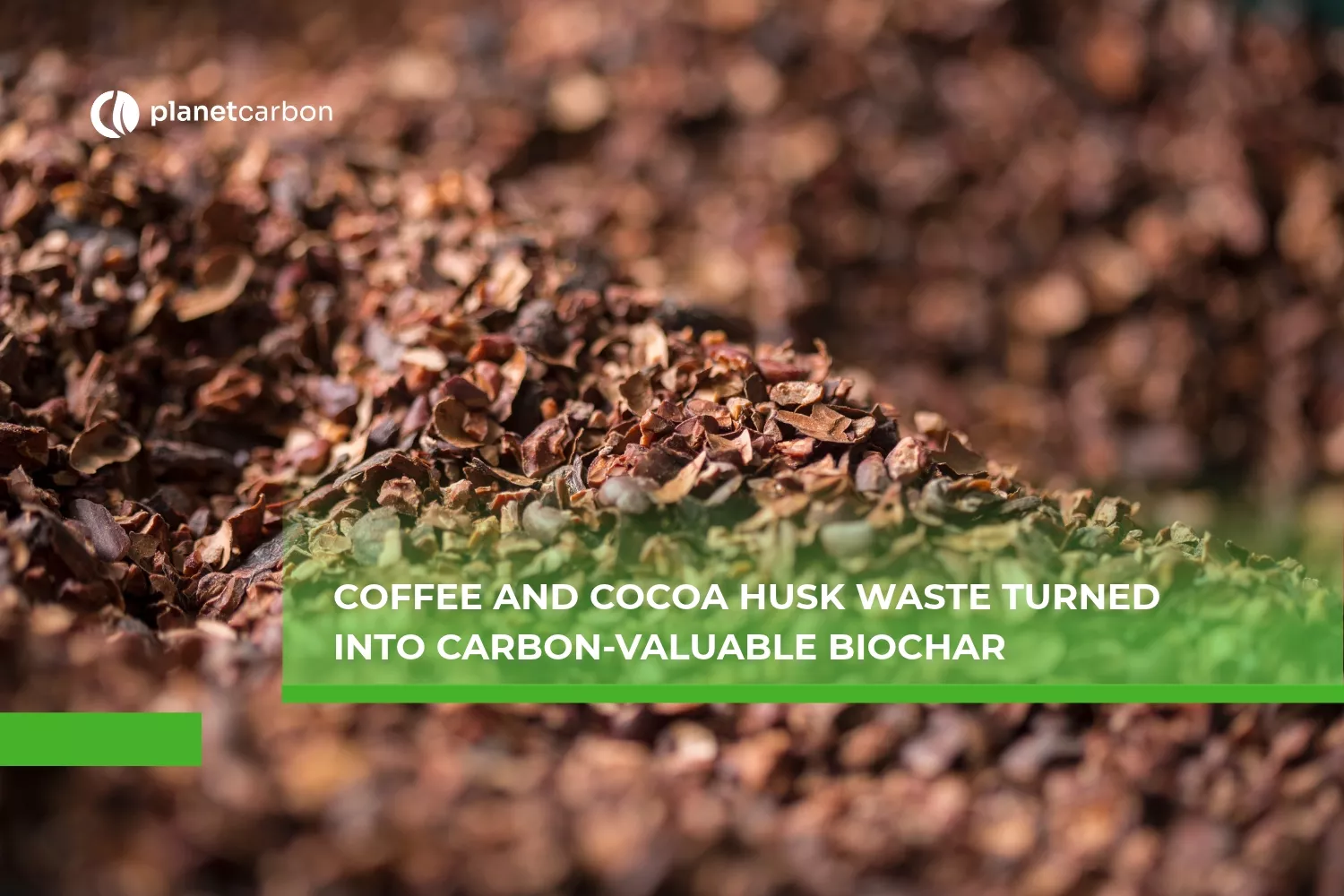
Coffee processing generates enormous volumes of husk waste, and for most plantations, this byproduct creates more burden than benefit. A single ton of coffee cherries produces roughly 400 to 450 kilograms of husk, meaning large-scale processors are dealing with hundreds of metric tons of residue every harvest cycle. Left in open piles, coffee husk biochar feedstock goes to waste in the most costly way possible: the organic matter decomposes, releasing methane and CO₂ directly into the atmosphere and adding measurably to a farm’s overall emissions footprint.
At the same time, corporate sustainability standards are tightening across every tier of the agricultural supply chain. More buyers, investors, and regulators now scrutinize supply chain emissions closely, and producers who cannot demonstrate a credible waste management and carbon reduction strategy risk being excluded from premium markets and ESG-aligned procurement partnerships.
Coffee husk biochar offers a practical, science-backed answer to both problems simultaneously. By converting this waste stream into a stable, carbon-rich material through controlled pyrolysis, agribusinesses can reduce emissions at the source, improve soil productivity on their own land, and generate verified carbon credits from a resource they already have on-site.
Why Coffee and Cocoa Husks Excel as Biochar Feedstock
Not all agricultural residues perform equally when converted into biochar. Coffee and cocoa husks stand out because of a combination of chemical composition, geographic concentration, and conversion economics that few other biomass types can match.
1. High Carbon Content and Optimal Pore Structure
Dried coffee husks contain a carbon content typically ranging between 40 and 50 percent of dry weight, a level that supports efficient pyrolysis and yields biochar with high fixed-carbon stability. The lignocellulosic structure of the husk also produces a highly porous char surface after thermochemical conversion, with surface area measurements often exceeding 200 to 400 m²/g depending on pyrolysis temperature. This pore architecture is what makes coffee husk biochar particularly effective as a soil amendment, enabling water retention, nutrient exchange, and microbial habitat in degraded agricultural soils.
2. Abundant Availability Concentrated in Production Hubs
Global coffee production reached approximately 174.5 million 60-kilogram bags in the 2022/2023 season according to the International Coffee Organization, generating a proportional volume of husk waste that is highly concentrated in specific growing regions across Indonesia, Brazil, Vietnam, Colombia, and Ethiopia. This geographic concentration is operationally important because it reduces feedstock logistics costs and allows processing facilities to be co-located near existing plantation infrastructure. For Indonesian producers in particular, Sumatra, Sulawesi, and Flores represent high-density biomass zones where aggregating sufficient feedstock volume for continuous biochar production is commercially viable.
3. Economically Favorable Conversion Ratio
Depending on moisture content and pyrolysis conditions, coffee and cocoa husks typically yield between 25 and 35 percent biochar by dry weight, a conversion ratio that is competitive with other lignocellulosic feedstocks. Beyond the biochar itself, the pyrolysis process also generates syngas and bio-oil as co-products, which can be recovered to offset the energy requirements of the kiln or reactor. This energy self-sufficiency potential is a meaningful factor in project economics, because it reduces external fuel inputs and improves the overall carbon balance of the production process.
Read Also : How to Make Corn Cob Biochar as a High-Carbon-Value Biomass Waste Solution
The Process of Turning Coffee and Cocoa Husk Waste into Biochar
Converting raw agricultural waste into carbon-credit-eligible biochar is a defined technical process, and each stage has direct implications for both product quality and downstream MRV credibility. The following three stages describe the core production pathway from raw feedstock to verified material.
1. Feedstock Preparation and Drying
Raw coffee and cocoa husks typically arrive at processing sites with moisture content between 30 and 60 percent, and this must be reduced to below 15 to 20 percent before pyrolysis can proceed efficiently. Excess moisture lowers reactor temperatures, increases energy consumption, and reduces biochar yield, so controlled drying is not a minor preprocessing step but a critical quality determinant. In well-designed projects, waste heat recovered from the pyrolysis reactor itself is redirected to the drying stage, reducing the energy cost of this step and improving the overall carbon footprint of the operation.
2. Controlled Pyrolysis as the Core of the Process
Pyrolysis is the thermochemical decomposition of organic material in the absence of oxygen, typically conducted at temperatures between 350°C and 700°C. The temperature range chosen directly affects the character of the resulting biochar: lower temperatures tend to produce higher yields with lower carbon stability, while higher temperatures produce lower yields with greater recalcitrance, meaning the carbon is more resistant to biological breakdown over time. For carbon credit eligibility, stability is paramount because the permanence of carbon storage is one of the central criteria assessed during verification under recognized international carbon certification standards.
3. Biochar Characterization and Quality Control
After pyrolysis, the biochar must be characterized through laboratory analysis to confirm its suitability for both agronomic application and carbon crediting. Key parameters include fixed carbon content, hydrogen-to-organic-carbon (H/Corg) ratio, polycyclic aromatic hydrocarbon (PAH) concentration, ash content, and pH. The H/Corg ratio is particularly significant for carbon markets because it serves as a proxy for long-term carbon stability, with a ratio below 0.7 generally considered indicative of biochar that will persist in soil for centuries rather than decades.
From Biochar to Carbon Credits: Understanding the MRV Pathway
Producing high-quality biochar is necessary but not sufficient for generating tradeable carbon credits. The biochar MRV process, covering Measurement, Reporting, and Verification, is the structured framework that transforms a physical product into a credible, auditable climate asset recognized in the voluntary carbon market.
1. Measurement: Quantifying Stored Carbon
Carbon quantification in a biochar carbon credit project begins with precise measurement of the amount of carbon stabilized in the biochar and the net emissions reductions achieved across the entire production chain. This includes accounting for emissions from feedstock collection, drying, pyrolysis, and transportation, offset against the baseline emissions that would have occurred had the husk decomposed naturally. The net carbon removal figure, typically expressed in tonnes of CO₂ equivalent per tonne of biochar applied, is calculated using methodologies aligned with recognized international carbon certification standards and must be reproducible and auditable.
2. Reporting: Documenting the Carbon Supply Chain
Reporting in the biochar MRV process requires comprehensive documentation covering feedstock origin and volume, production parameters, biochar characterization results, and the chain of custody from production site to point of application. This documentation chain serves two purposes simultaneously: it provides the evidentiary basis for credit issuance and it enables buyers and investors to conduct independent due diligence on the quality and integrity of the credits. Robust reporting systems are not a bureaucratic overhead but a competitive asset, because credits backed by transparent, auditable data command higher buyer confidence and are better positioned to meet the Core Carbon Principles (CCP) criteria established by the Integrity Council for the Voluntary Carbon Market (ICVCM).
3. Verification: Validation by Independent Auditors
The final stage of the MRV pathway involves third-party review of all measurement data and documentation by an accredited independent verification body. This body assesses whether the project methodology was applied correctly, whether the carbon quantification is accurate and conservative, and whether the biochar product meets the stability and quality thresholds required for credit issuance on a publicly auditable carbon registry. Verification is typically conducted on an annual basis, and the cost of this process is a line item that project developers must plan for from the outset.
Real Economic Value: What Agricultural Companies Can Gain
The financial case for converting coffee and cocoa husk waste into biochar is stronger today than it has been at any previous point, because multiple value streams can be realized simultaneously from a single integrated project.
The most direct revenue stream comes from the sale of verified carbon credits generated through the biochar MRV process. Biochar carbon removal credits have consistently traded at a premium in the voluntary carbon market relative to many other credit types, partly because of their long permanence profile and partly because corporate buyers seeking to meet Science Based Targets initiative (SBTi) alignment or net-zero commitments increasingly prioritize high-durability carbon removals. Premium pricing for engineered carbon removal credits in this category has ranged widely, but well-documented biochar projects have reported prices that make the economics compelling for agribusinesses operating at scale.
Beyond carbon revenue, the biochar itself has direct agronomic value. Applied to plantation soils, biochar from coffee husk improves water holding capacity, reduces the need for synthetic fertilizer inputs, and over time rebuilds soil organic matter in areas degraded by intensive cultivation. For producers managing their own farmland, this translates into measurable input cost savings, and for those selling biochar as a soil amendment product, it opens an additional commercial channel.
There is also a compliance and market access dimension that should not be underestimated. Under Indonesia’s carbon economy framework as defined in Presidential Regulation No. 110 of 2025, which replaced the earlier Perpres 98/2021, agricultural sector actors are increasingly expected to participate in emissions accounting and carbon trading mechanisms. Agribusinesses that build their biochar and MRV infrastructure now will be better positioned to meet these obligations proactively, rather than facing reactive compliance costs later.
Start a Biomass Supply Partnership with Planet Carbon
If your operation generates significant volumes of coffee or cocoa husk waste, you are already holding the raw material for a viable carbon removal project. What determines whether that potential becomes real economic value is having the right technical and commercial infrastructure to develop, validate, and commercialize it properly.
Planet Carbon works with agribusinesses and biomass producers to build end-to-end coffee husk biochar projects, from feedstock assessment and pyrolysis process design through to MRV implementation and carbon credit commercialization. Our integrated platform is built specifically for the agricultural biomass context, meaning we understand both the operational realities of plantation-scale waste management and the rigor required by the voluntary carbon market.
If you are exploring what a biomass supply partnership could look like for your business, or simply want to understand the technical and financial feasibility of a biochar project at your site, the Planet Carbon team is ready to have that conversation. Reach out through planetcarbon.earth to discuss your feedstock volumes, project location, and carbon strategy goals. There is no obligation in starting the conversation, and the earlier a project is scoped correctly, the stronger its long-term credit quality and commercial outcome.
Referensi:
- International Coffee Organization: Global coffee production data, 2022/2023 season – https://www.ico.org/
- Lehmann, J. and Joseph, S. (eds.), Biochar for Environmental Management: Science, Technology and Implementation, 2nd edition, Routledge, 2015 – foundational data on biochar carbon content, H/Corg ratios, and pyrolysis parameters.
- Integrity Council for the Voluntary Carbon Market (ICVCM): Core Carbon Principles (CCP) framework – https://icvcm.org/the-core-carbon-principles/
- Science Based Targets initiative (SBTi): Corporate net-zero standards and carbon removal criteria – https://sciencebasedtargets.org/
- Presidential Regulation of the Republic of Indonesia No. 110 of 2025 on the Implementation of the National Carbon Economy (Perpres 110/2025), replacing Perpres 98/2021 – https://peraturan.go.id/id/perpres-no-110-tahun-2025
Read Also : Sugarcane Bagasse Biochar: Sustainable Carbon and Agriculture Solutions for the Sugar Industry