

Emissions keep rising even as more organizations declare climate commitments, partly because the term what is carbon neutral is used inconsistently across policy documents, corporate disclosures, and scientific literature. A company can claim carbon neutrality by purchasing offsets with little scrutiny, while a research institution applies the same label only after rigorous lifecycle accounting. The gap between these two uses is not just semantic.
When the definition is unclear, so is accountability. Governments risk endorsing incomplete frameworks, researchers struggle to compare studies across methodologies, and investments intended to address the climate crisis may end up funding little more than optics. The credibility of an entire sector can erode when one vague claim goes unchallenged.
Understanding what carbon neutral actually means, in precise technical and policy terms, is the starting point for any credible climate strategy. This guide breaks down the science, the accounting standards, and the removal mechanisms that separate genuine carbon neutrality from vague aspiration.
What is Carbon Neutral?
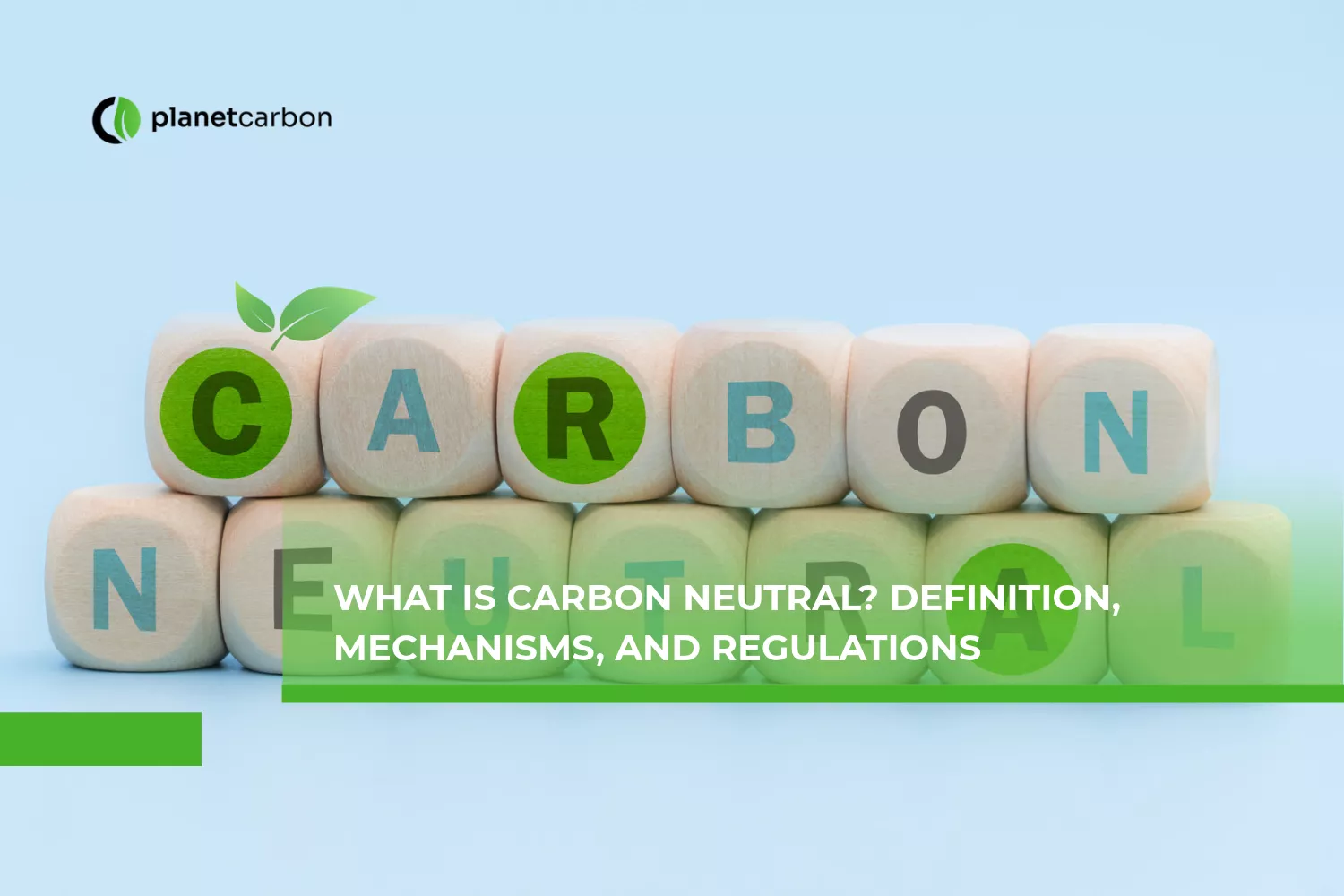
What is carbon neutral at its core refers to a condition in which the net greenhouse gas emissions associated with an activity, organization, product, or territory equal zero over a defined period. This is achieved either by eliminating emissions entirely or by balancing remaining emissions with an equivalent amount of carbon removed from the atmosphere.
The carbon neutral definition draws heavily from the GHG Protocol framework, which categorizes emissions into three scopes: direct emissions from owned sources (Scope 1), indirect emissions from purchased energy (Scope 2), and all other value chain emissions (Scope 3). A rigorous carbon neutral claim must account for all three scopes and apply only to a clearly bounded system, whether a single product, a facility, or an entire organization.
The term is most meaningful when paired with a verifiable measurement baseline, a time-bound commitment, and a transparent disclosure of which emissions were reduced versus offset. Without these three elements, a carbon neutral label functions more as a marketing claim than a scientifically defensible position.
Why Carbon Neutral Is Increasingly Relevant for Public Policy
Policy frameworks at both national and international levels are converging around measurable climate outcomes, which has elevated the carbon neutral standard from a voluntary corporate goal to a regulatory expectation. The Paris Agreement obliges signatory nations to submit and regularly strengthen Nationally Determined Contributions (NDCs), creating downstream pressure on industries and corporations to demonstrate their contribution to national targets.
From a public finance perspective, carbon pricing mechanisms including carbon taxes and emissions trading systems are progressively internalizing the cost of greenhouse gas emissions into business decisions. Organizations that already operate under a verifiable carbon neutral framework are better positioned to navigate these pricing environments without sudden cost exposure.
For investors and procurement officers operating under ESG mandates, carbon neutrality serves as an early-stage indicator of operational discipline and long-term risk management. Frameworks such as the Science Based Targets initiative (SBTi) and the Integrity Council for the Voluntary Carbon Market (ICVCM) with its Core Carbon Principles (CCP) have further raised the bar by establishing clear criteria that distinguish high-integrity claims from superficial ones.
Mechanisms for Achieving Carbon Neutral
There is no single pathway to carbon neutrality. In practice, credible carbon neutral strategies rely on a combination of three distinct mechanisms, each with its own technical requirements and verification demands.
1. Emission Reduction at the Source
The most foundational mechanism is reducing emissions directly within an organization’s operational boundary. This includes transitioning to renewable energy, improving energy efficiency, redesigning supply chains, and substituting high-emission materials with lower-impact alternatives.
Source reduction carries the highest integrity because it permanently removes emissions from the system rather than compensating for them elsewhere. Science Based Targets initiative (SBTi) guidance, for instance, requires organizations to prioritize deep decarbonization across their value chain before relying on any form of offset or removal.
Progress in this area is typically measured against a verified emissions baseline established using GHG Protocol carbon accounting methodologies. Transparent annual reporting against this baseline is what distinguishes a genuine reduction trajectory from a static claim.
2. Carbon Offset and Carbon Removal
Where emissions cannot yet be eliminated, organizations can compensate through carbon credits representing either avoided emissions (offset) or actively sequestered carbon (removal). Carbon credits are issued in standardized units, with one credit typically representing one tonne of CO2 equivalent either avoided or removed.
Not all credits carry equal integrity. Under the Core Carbon Principles (CCP) developed by the ICVCM, high-quality credits must demonstrate additionality (the removal or avoidance would not have occurred without the project), permanence (the carbon stored will not be re-released), and accurate quantification verified by an accredited independent verification body. Credits that meet these standards, registered under a recognized international carbon certification standard and listed on a publicly auditable carbon registry, provide the accountability layer that a carbon neutral claim requires.
Carbon removal instruments, particularly those with high permanence ratings such as enhanced rock weathering, direct air capture, and biochar carbon removal, are increasingly preferred over avoidance-based offsets in voluntary carbon market frameworks. The distinction matters because removal directly addresses atmospheric CO2 concentrations rather than simply slowing the rate of new additions.
3. The MRV Process as the Foundation of Credibility
Measurement, Reporting, and Verification, widely referred to as MRV, is the process infrastructure that gives a carbon neutral claim its technical legitimacy. MRV carbon neutrality frameworks specify how emissions and removals are quantified, how that data is reported to regulators or registries, and how an independent third party confirms the accuracy of those figures.
Without a functioning MRV system, even a genuinely carbon neutral organization cannot defend its claim in a regulatory or commercial context. This is particularly relevant in emerging markets where institutional capacity for carbon accounting is still developing, and where weak MRV can undermine an entire national carbon program.
A robust MRV process also enables continuous improvement. By creating an auditable data record over time, organizations can identify the highest-impact areas for further reduction, model the cost-effectiveness of different removal instruments, and demonstrate progress to regulators, investors, and counterparties.
Read Also : 10 Effective Ways to Reduce Carbon Emissions in Everyday Life
Carbon Neutral Regulatory Framework in Indonesia
Indonesia’s carbon market and neutrality governance is anchored in Presidential Regulation No. 110 of 2025 (Perpres 110/2025), which replaced the earlier Perpres 98/2021 and significantly strengthened the regulatory architecture for Indonesia’s National Carbon Economic Value (NEK) system. The regulation establishes mandatory participation thresholds, sectoral emission ceilings, and the institutional roles of relevant government bodies in overseeing carbon trading and retirement.
Under this framework, emissions-intensive sectors are required to measure and report their greenhouse gas outputs through a government-administered registry, with carbon credit transactions taking place on an official carbon exchange regulated by the national financial authority. Carbon neutral claims made within the Indonesian regulatory jurisdiction must therefore align with both the national MRV requirements under Perpres 110/2025 and, for internationally marketed credits, with recognized international carbon certification standards.
For project developers and corporations operating in Indonesia, this dual compliance environment creates an important structural consideration. Domestic regulatory approval and international market credibility are not automatically the same thing, so aligning project design with both frameworks from the outset reduces audit risk and increases the commercial value of resulting credits. Planet Carbon’s integrated platform is specifically designed to address this dual-track requirement.
The Role of Biochar as a High-Quality Carbon Removal Instrument
Biochar carbon removal has emerged as one of the more scientifically robust carbon removal mechanisms available within the voluntary carbon market. Biochar is produced by heating organic biomass, including agricultural residues, in a low-oxygen environment through a process called pyrolysis. The resulting stable carbon compound resists biological decomposition for hundreds to thousands of years, effectively locking atmospheric carbon into a solid form.
From a carbon accounting standpoint, biochar carbon removal is attractive because the permanence of the sequestered carbon is measurable and verifiable. Lifecycle assessments that meet GHG Protocol carbon accounting standards can quantify the net carbon benefit by subtracting emissions generated during production and transport from the total carbon stabilized in the biochar. This makes it one of the few removal pathways where the carbon neutral definition can be applied with high quantitative precision.
Biochar also addresses a co-benefit that most other removal mechanisms cannot claim: it derives from agricultural waste streams that would otherwise decompose and release CO2 and methane. In countries like Indonesia, where smallholder agriculture generates substantial biomass residues, biochar production converts a liability into a verifiable climate asset, while simultaneously improving soil health and agricultural productivity for the communities involved.
The Difference Between Carbon Neutral and Net Zero Carbon
The terms carbon neutral and net zero are often used interchangeably, but they carry meaningfully different implications at both the organizational and national level. Net zero carbon, as defined by the Science Based Targets initiative (SBTi) and the Oxford Principles for Net Zero Aligned Offsetting, requires deep decarbonization across all value chain emissions before any residual amount can be neutralized through permanent carbon removal. Carbon neutrality, by contrast, can in principle be achieved by balancing any level of remaining emissions with an equivalent quantity of offset or removal credits.
The practical implication is that a net zero commitment signals structural transformation of an organization’s operations, while a carbon neutral label may reflect an earlier stage of the journey. Both have legitimate roles in a climate strategy, provided the distinction is disclosed transparently.
The ICVCM’s Core Carbon Principles and the GHG Protocol guidance on beyond-value-chain mitigation provide a technical bridge between the two concepts by specifying which types of removal credits are appropriate for which type of claim. Organizations that understand this distinction are better equipped to set targets that are both commercially realistic and scientifically defensible.
Carbon Neutral Is a Starting Point, Not the Final Destination
Carbon neutral status is best understood as a verifiable milestone on a longer decarbonization trajectory, not an endpoint. Organizations that treat it as a final destination risk locking in current emission levels and missing the structural transformation that genuine climate action requires.
The most credible carbon neutral strategies are those that combine immediate, measurable emission reductions with high-integrity removal instruments, governed by transparent MRV processes and aligned with recognized international frameworks. That combination is what converts a claim into a contribution.
If your organization is working to build or validate a carbon neutral strategy, whether for a project, a product line, or an entire operation, the Planet Carbon team is available to walk through the technical and regulatory considerations with you. Reach out to schedule a discussion and explore how an integrated carbon solutions approach can move your climate commitments from intention to implementation.
Referensi:
- Government of Indonesia, Perpres No. 110 Tahun 2025: Legal basis for Indonesia’s NEK carbon economic value system, replacing Perpres 98/2021 – https://peraturan.go.id/id/perpres-no-110-tahun-2025
- GHG Protocol: Scope 1, 2, and 3 emissions accounting standards and corporate carbon accounting methodology – https://ghgprotocol.org
- Science Based Targets initiative (SBTi): Corporate net zero standard and guidance on value chain decarbonization requirements – https://sciencebasedtargets.org
- Integrity Council for the Voluntary Carbon Market (ICVCM): Core Carbon Principles (CCP) for high-integrity voluntary carbon credits – https://icvcm.org
- Oxford Principles for Net Zero Aligned Offsetting: Guidance on the appropriate role of offsets and removals in net zero strategies – https://www.smithschool.ox.ac.uk/research/oxford-offsetting-principles
- IPCC Sixth Assessment Report (AR6): Background data on atmospheric CO2 concentrations and carbon removal pathways – https://www.ipcc.ch/assessment-report/ar6/
Read Also : What is Climate Change? Definition, Causes, Impacts, and Solutions